Baltic and the Problem of Nostalgia Done Too Well
The small seconds hand of the Baltic MR01 makes its quiet circuit at seven-thirty, not quite where the eye expects it to be, cutting a modest orbit through a dial that seems to have been recovered from another decade. The numerals are flourished but not extravagant; the minute track is fine enough to suggest ink rather than metal; the case, at 36 millimetres, refuses the swollen posture that so many modern watches adopted before the market remembered the wrist. Under a glass, the movement shows its micro-rotor, a complication historically associated with names far older and heavier than Baltic. Yet the watch is not old. It is a recent object, born in the age of pre-orders, social media launches, and the efficient intimacy of microbrand culture.
This is where Baltic becomes difficult to discuss fairly. The watches are too easy to like from a distance, and too carefully composed to dismiss as costume. They are not replicas in the blunt sense. They do not merely trace the outline of one famous reference and ask borrowed glamour to do the work. Instead, they gather the grammar of mid-century watchmaking—sector dials, beads-of-rice bracelets, blued accents, stepped cases, compact diameters, acrylic domes, gilt warmth—and arrange it with contemporary fluency. The result is often convincing enough that the usual complaint, that nostalgia is lazy, begins to feel inadequate. Baltic’s problem is not that it remembers the past badly. Its problem is that it remembers it almost too well.
The brand’s origin story is itself unusually suited to this terrain. Founded in France in 2017 by Étienne Malec, Baltic emerged from a familial archive: photographs, watches, and an inherited fascination with the objects kept by Malec’s father. That detail matters because Baltic has always seemed less concerned with inventing a design language than with curating one from memory. Its early Bicompax chronographs wore the influence of 1940s and 1950s two-register watches openly, powered by the hand-wound Seagull ST1901, a descendant of the Venus 175 architecture acquired by Tianjin in the 1960s. This was not haute horlogerie, but it was mechanically legible. A column-wheel chronograph, visible through the back in some versions, brought an old rhythm at a price the vintage market no longer permits.
In the Bicompax, the appeal rested on proportion before novelty. Around 38 millimetres, with domed crystal, thin bezel, and long but not theatrical lugs, it studied the old chronograph not as an image but as a set of relationships. The sub-dials sat with enough room to breathe. The typography did not shout. The pushers looked pressed from another era, yet the watch was unembarrassed by its modern manufacture. It was not trying to fool anyone attentive. The case finishing was clean, the dial printing crisp, the movement choice pragmatic. But the emotional register was unmistakably backward-facing. Baltic had found a way to make the past feel available without requiring patina, service bills, or the moral uncertainty of relumed hands.
That availability is central to the brand’s rise. Vintage watches once carried the romance of discovery: odd proportions, anonymous case makers, dial variants that slipped through catalogues, movements that needed sympathy. They also carried risk. A tropical dial could be damage in better lighting. A polished case could erase the sharpness that gave a watch its character. A charming chronograph could conceal worn parts no watchmaker wanted to source. Baltic entered at a moment when the mythology of vintage had outpaced the pleasure of owning vintage. The brand offered not correction exactly, but translation. It took the mood and left behind much of the anxiety.
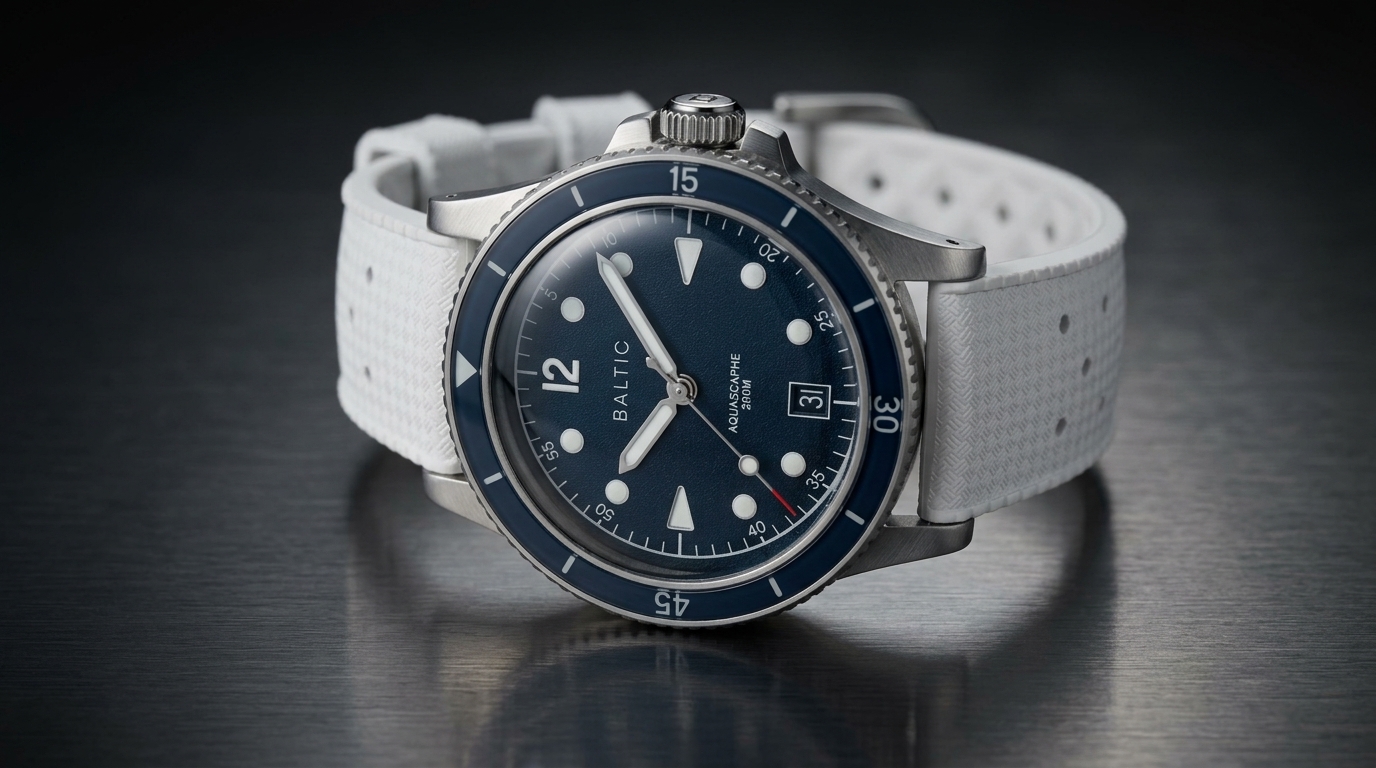
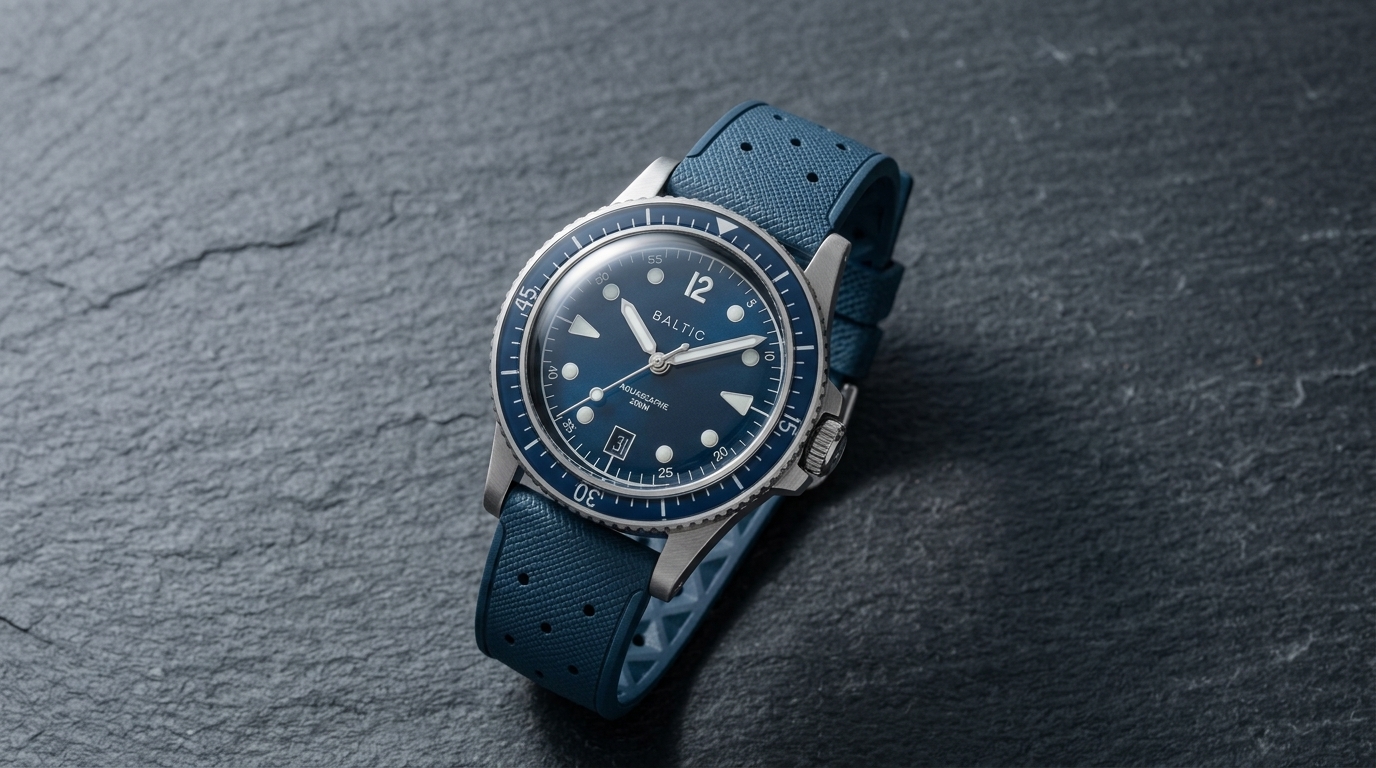
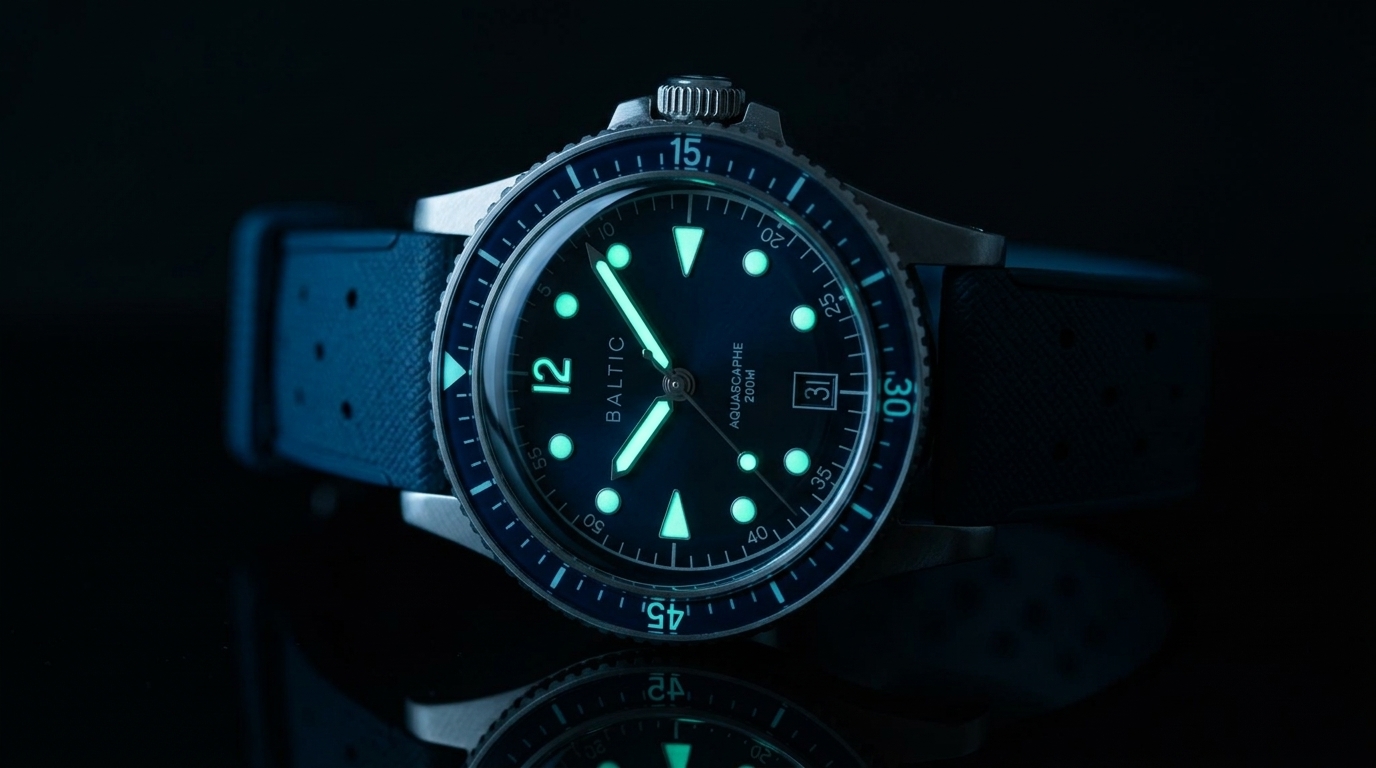
The Aquascaphe sharpened the lesson. Here was a dive watch fluent in the language of the 1960s: skin-diver restraint, sapphire bezel with a depth of colour approximating old Bakelite, luminous plots that nodded toward age without pretending to possess it. At roughly 39 millimetres across and manageable in thickness, it avoided the heavy equipment cosplaying common to modern divers. The movement, often Miyota or later automatic calibres depending on version, was chosen less for romance than reliability and serviceability. The watch did not compete with the technical extremity of contemporary professional divers. It asked a different question: how much of the emotional charge of a vintage Submariner, Fifty Fathoms, or obscure compressor-era tool watch can be summoned without copying any one of them completely?
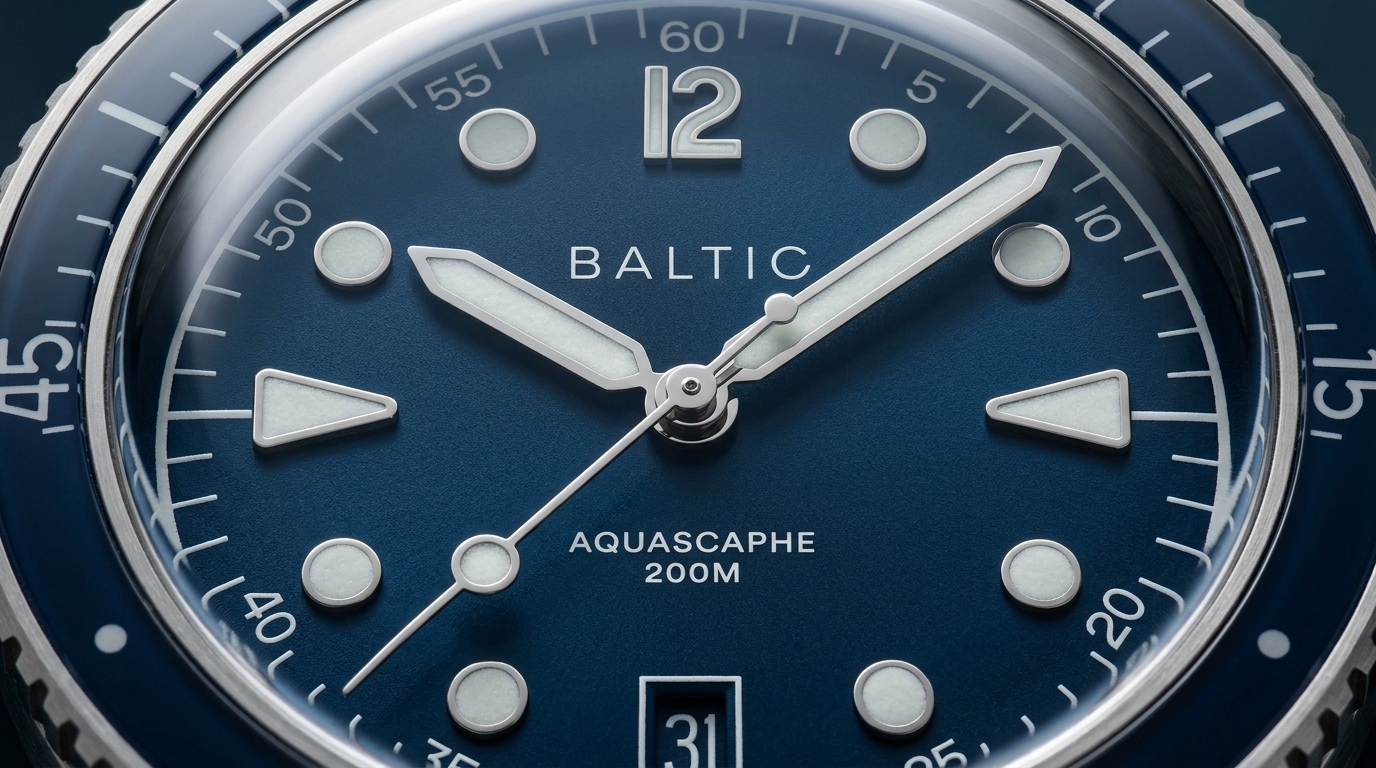
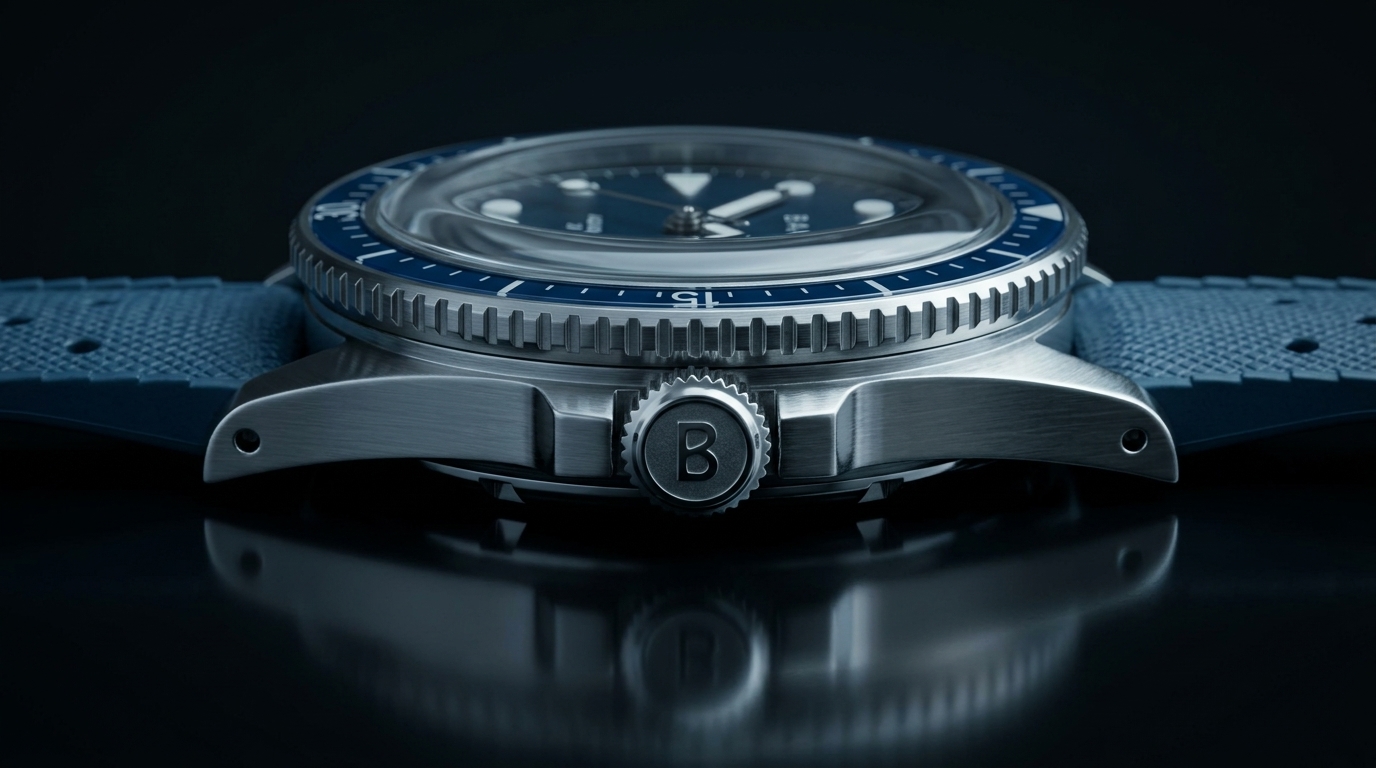
The answer, in Baltic’s case, was: a great deal. Perhaps too much. When nostalgia is clumsy, it announces its failure. The fake lume looks tea-stained, the case is oversized, the typography collapses into pastiche, and the whole exercise can be set aside as theatre. Baltic is more troublesome because the company often gets the minor things right. A bracelet tapers properly. A crown is not inflated for photographs. A dial recognizes the value of negative space. The watches are not perfect; no watch assembled at these price points can be. But their intelligence is apparent enough that criticism must move past accusations of copying and toward something more uncomfortable: what happens when a young brand becomes exceptionally skilled at evoking age?
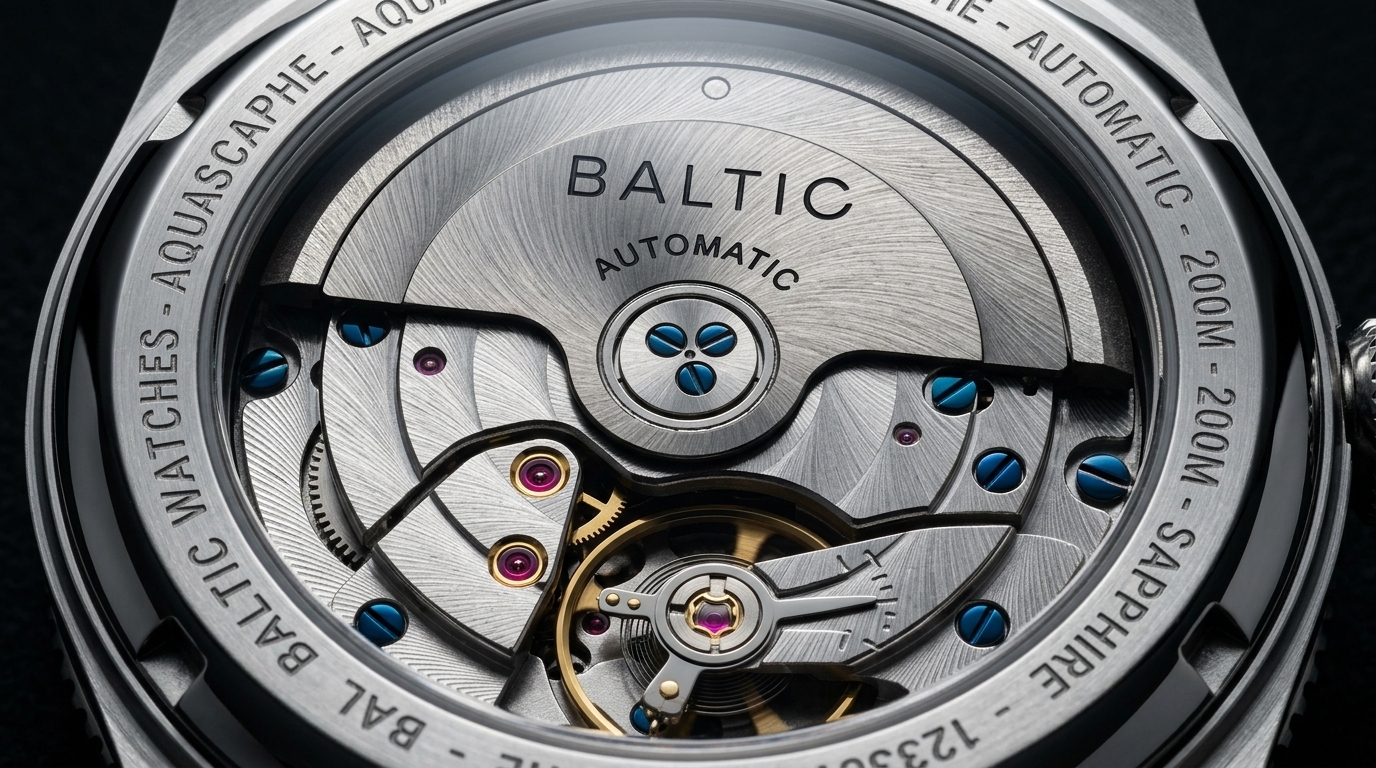
The MR01 is the most revealing object in this regard. At first glance, it seems to belong to the lineage of small, formal watches with Breguet numerals and off-centre seconds, the sort of thing that feels linked, in the public imagination, to Patek Philippe, Vacheron Constantin, Universal Genève, and the quieter corners of pre-war wristwatch design. Yet inside is the Hangzhou CAL5000A, an automatic micro-rotor movement from China, decorated visibly and positioned as part of the watch’s appeal. A micro-rotor in a watch of this cost remains a provocation, even if the construction and finishing are not to be confused with the high Swiss examples that made the architecture famous. It is a clever decision because it gives the watch a horological talking point beyond appearance. It also complicates the nostalgic spell. The face looks European and old; the engine is global and contemporary, a piece of modern supply-chain possibility.
This tension may be Baltic’s most honest quality. The watches appear to come from memory, but they are products of a very current ecosystem. Their cases, crystals, dials, and movements reflect a world in which small brands can source competent components, assemble a coherent identity, and speak directly to collectors without waiting for an old distribution network to grant permission. Baltic’s nostalgia is therefore not a retreat from modernity. It is a method of surviving inside it. The brand uses the past as a shared language in a fragmented market, where a sector dial can communicate faster than a manifesto and a 36 millimetre case can signal taste more quietly than a campaign.
Still, there is a cost to fluency. When every detail is calibrated to summon warmth, the watch risks becoming less an object than a mood board made unusually tangible. The danger is not deception; Baltic rarely pretends its watches are anything other than new watches with old references. The danger is that the pleasure becomes too frictionless. Real old watches are strange. Their charm often comes from accidents: a case diameter dictated by movement availability, a dial supplier’s inconsistency, a pusher profile chosen by necessity, a bracelet that pulls hair and rattles with a personality no designer would now approve. Baltic smooths these unruly qualities into agreeable form. It gives the collector the emotion of discovery without the inconvenience of discovery itself.
That smoothing can be seen as generosity. Not everyone can or should chase vintage. The market has become expensive, opaque, and at times absurd. A person drawn to the shape of old chronographs or the civility of smaller dress watches may prefer a new Baltic for defensible reasons: warranty, availability, water resistance, modern tolerances, replaceable parts, and the absence of forensic dial debates. There is nothing inherently nobler about a watch simply because it has survived. Age can confer depth, but it can also conceal neglect. Baltic’s success rests partly on exposing the vanity in certain forms of vintage purism. If what is loved is proportion, typography, mechanical involvement, and a restrained case, then a new watch may satisfy the desire with fewer illusions than an auction listing does.
Yet the editorial discomfort remains. A watch brand cannot live forever on borrowed silhouettes, however sensitively arranged. The more Baltic demonstrates its eye, the more the burden shifts from taste to authorship. Early collections could be forgiven their debt to the archive because the brand was young and the work was strong. But competence raises expectations. When Baltic releases another watch with an old-world dial, the question is no longer whether it can execute nostalgia. That has been answered. The question is whether it can escape being defined by the excellence of that execution.
Some of the later pieces suggest an awareness of this trap. The Hermétique, with its field-watch premise, internal tension between utility and refinement, and compact case, still speaks in historical tones but feels less like an extracted photograph. The Prismic, with its multi-faceted case and dressier ambitions, attempts a more individual vocabulary, even while leaning on the codes of mid-century refinement. Limited collaborations and special editions sometimes show Baltic pushing colour, texture, or case architecture further than the core line allows. These are small movements, not revolutions. But watch design rarely advances by revolution. It advances by tiny permissions granted to the eye until what once felt risky begins to feel inevitable.
The challenge is especially acute because Baltic’s audience is unusually literate. These are not watches aimed only at people who need a pleasant dial and a decent movement. They circulate among collectors who know the references. A sector dial invites comparisons to Longines, Omega, and Patek. A bicompax chronograph calls up Universal Genève, Gallet, and countless anonymous military and civilian pieces. A beads-of-rice bracelet carries the memory of Gay Frères whether or not the clasp bears any relation to that history. The collector sees the lineage instantly. Baltic relies on that recognition. But recognition can become a closed room. If every pleasure depends on identifying the ancestor, the descendant struggles to cast its own shadow.
There is also the question of patina, that overused word which nevertheless names a real hunger. Baltic has mostly avoided the worst habits of artificial ageing. Its watches often prefer cream, silver, blue, black, and gilt tones rather than aggressive faux decay. But the broader market around it has trained buyers to consume age as a colour choice. Lume is not aged by radium, tritium, ultraviolet light, moisture, or decades in a drawer; it is selected from a catalogue. Warmth becomes a finish. History becomes a shade. Baltic is more tasteful than many in this arena, but its best watches still participate in the transformation of time into design language. A new watch can evoke oldness, but it cannot have lived. That distinction may seem obvious, yet the market repeatedly asks objects to blur it.
The irony is that Baltic’s watches may age more interestingly if the brand eventually allows them to stop performing age so carefully. A first-generation Bicompax will one day be a watch from the late 2010s, not from the 1940s it recalls. An early Aquascaphe will carry the marks of actual use: scratches on a polished bevel, dullness on a clasp, perhaps a bezel insert faded by real light rather than selected warmth. The MR01, with its Chinese micro-rotor and French-designed dial, may eventually tell a story more specific than the one its numerals initially suggest. It may come to represent the moment when enthusiast watchmaking became international, digitally distributed, historically self-aware, and unashamed of mixing prestige cues with accessible manufacturing. That story is not merely nostalgic. It belongs to the present.
For now, Baltic occupies a peculiar moral climate in horology. It does not deserve the cynicism reserved for brands that strip-mine the past without sensitivity. Nor should it be protected from criticism by the affordability and charm of its work. Serious watch writing must be able to hold both positions at once. Baltic makes watches of real compositional intelligence. It also exposes how hungry the market has become for the reassurance of familiar forms. Its cases are small because collectors have relearned the pleasure of smallness. Its dials are balanced because imbalance has become less forgivable. Its movements are chosen to give mechanical conversation without pretending to impossible grandeur. All of this is admirable. All of it is also evidence of a watch world looking backward with almost devotional attention.
Nostalgia in watches is not a minor force. Mechanical horology itself now operates partly as a nostalgic act, since the wristwatch no longer needs springs and escapements to tell time. The industry survives by transforming an obsolete technology into culture, craft, identity, and pleasure. In that sense, every mechanical watch is already haunted. A Baltic simply makes the haunting visible. The ticking inside the case is not only a measure of seconds but a kind of argument: that old solutions still have emotional value, that scale matters, that a dial can be read as literature, that a chronograph pusher can give satisfaction disproportionate to its function. These arguments are persuasive because they are true.
But a truth repeated too beautifully can become a comfort that prevents further thought. Baltic’s finest watches create that risk. They allow the collector to rest in the idea that the best proportions have already been found, that the vocabulary of 1935 or 1965 only needs cleaning, resizing, and careful pricing. The past becomes not a source but a ceiling. For a brand with Baltic’s eye, that would be a waste. The company has already shown that it can distinguish homage from incoherence, memory from mere borrowing, restraint from emptiness. The next and harder task is to make watches that future brands might one day quote without simply quoting the same ancestors again.
The small seconds hand continues its orbit. The chronograph registers wait in their old symmetry. The dive bezel sits with its polished depth, ready to measure elapsed minutes in a world where few lives depend on such measurement. Baltic’s watches are convincing because they understand that horology is made of gestures as much as specifications: the way a lug falls, the way a dial breathes, the way a crystal bends the minute track at its edge. The problem is that they understand it so well. Nostalgia poorly done can be ignored. Nostalgia done this well asks for a more serious verdict. It is beautiful, disciplined, and sometimes a little too obedient to ghosts.