Longines and the Elegance of Not Needing to Win
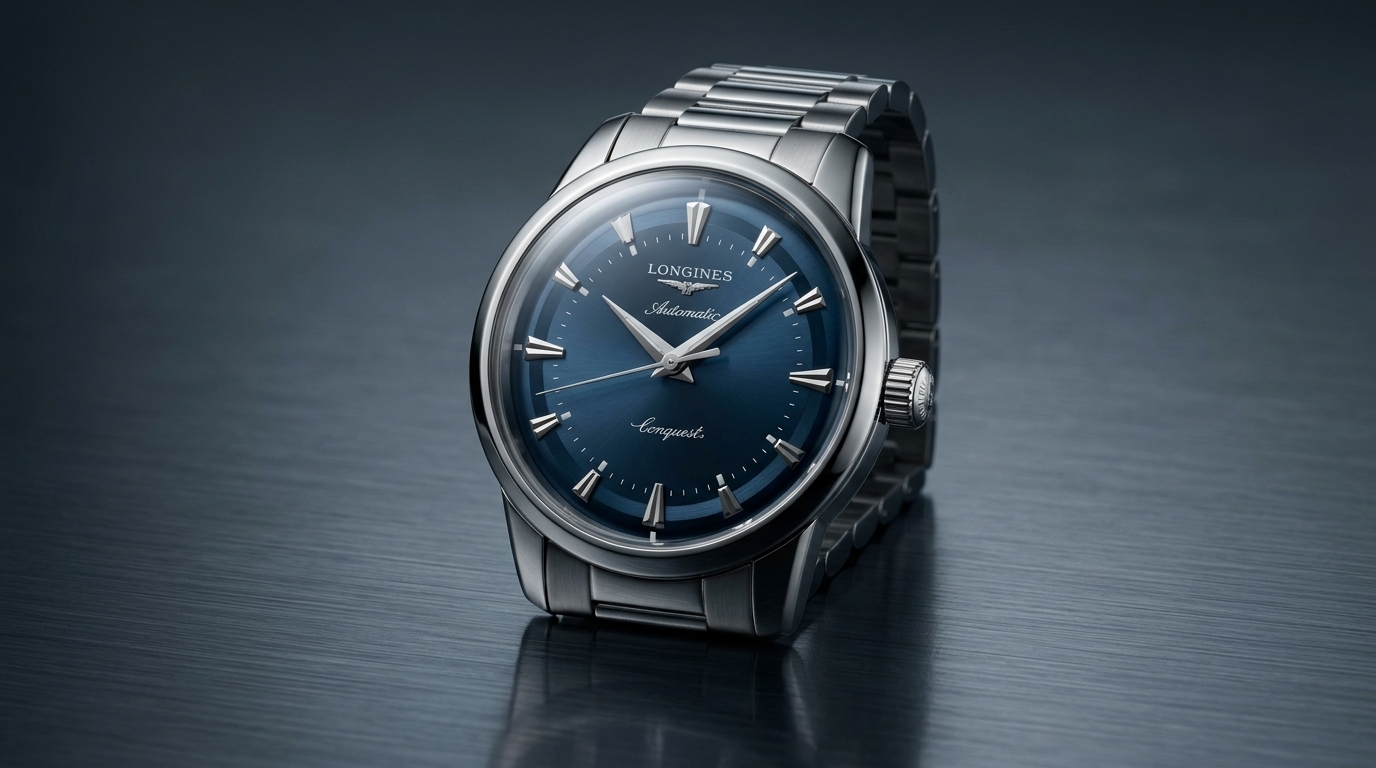
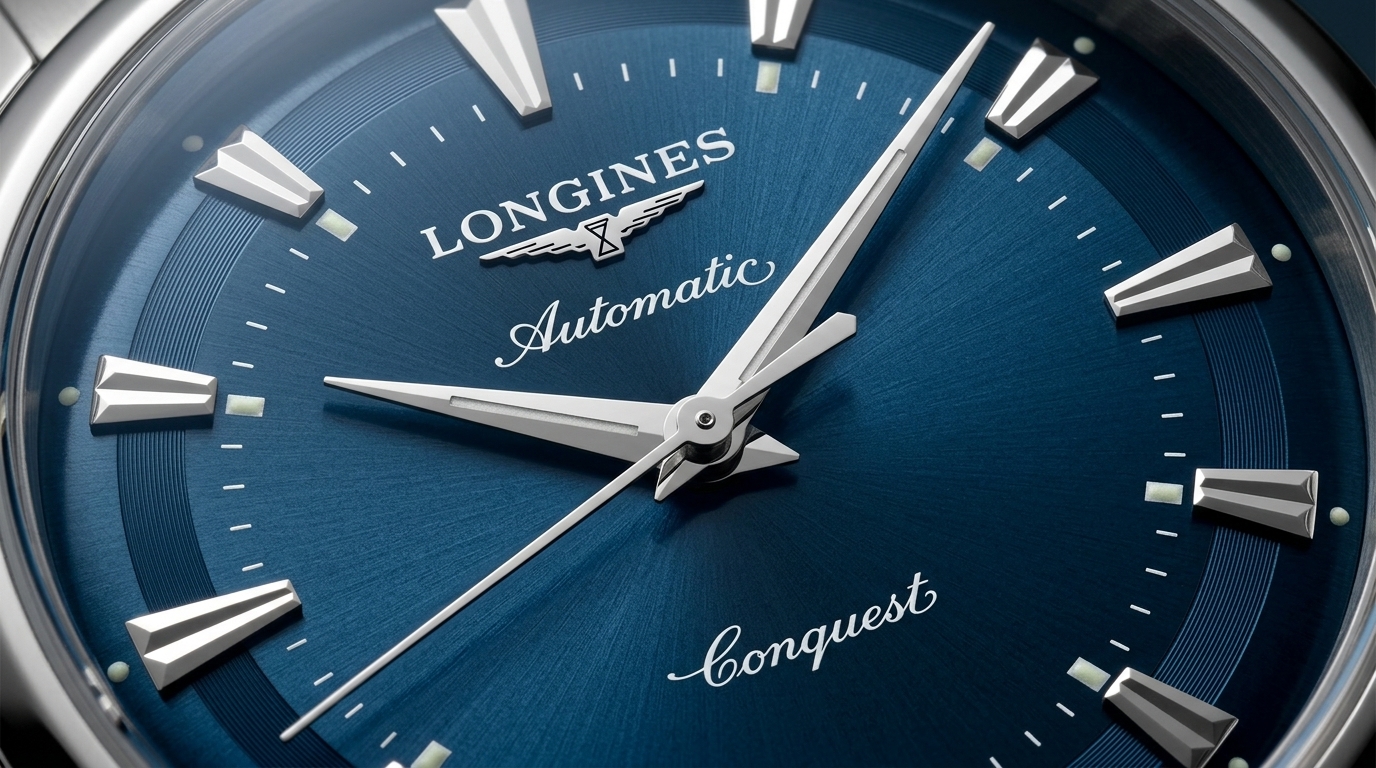
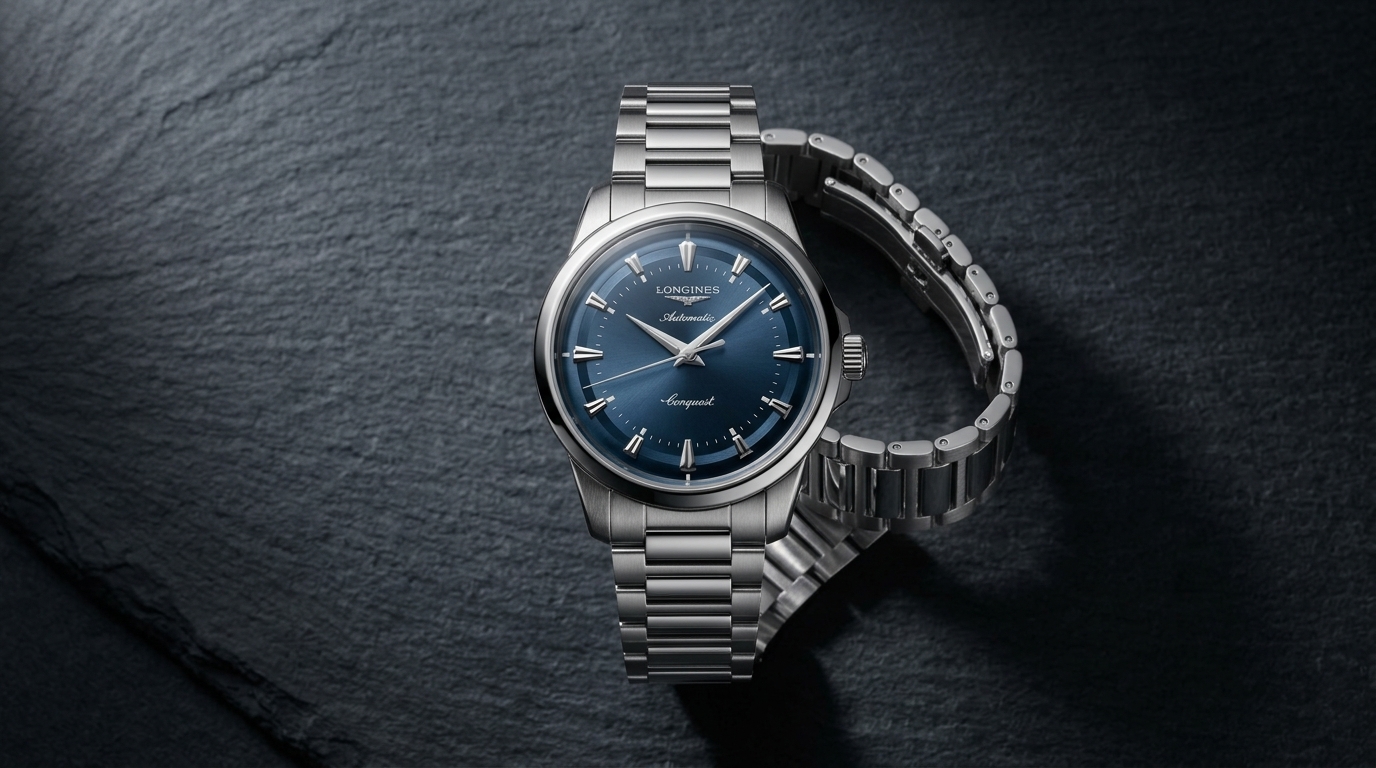
At 10:10, the hands make their courteous angle across a Longines dial, neither theatrical nor shy, while the winged hourglass sits beneath twelve with the small authority of something that has survived fashion by declining to raise its voice. The case catches light along the bezel, lets it go, then holds a quieter gleam on the flank. Nothing lunges for attention. The minute track does its work. The date, if there is one, stays within its allotted window. The crown is proportionate, the lugs taper without drama, and the watch seems less designed to conquer the room than to remain suitable after the room has emptied.
This is a difficult kind of elegance to describe because it depends on refusal. Longines has never lacked the instruments with which to boast. Its archive is thick with aviation watches, timing devices, chronographs, observatory pedigrees, and cases whose signatures belong to particular decades with unusual clarity. The company was formally registered in 1889, the winged hourglass among the oldest watch trademarks still in use, and its home in Saint-Imier gives the name a geography as well as a logo. Yet the modern Longines rarely behaves as if history were a weapon. It carries history more like a cufflink inherited from a precise relative: visible, useful, but not brandished.
There are houses that build their identities around victory. They point toward the summit, the regatta, the racetrack, the auction room. Their watches arrive carrying conquest in the typography. Longines has known timing as intimately as any of them. It timed horse races in the nineteenth century, lent its instruments to aviation, and made chronographs that collectors now discuss with the hushed appetite usually reserved for rarities behind museum glass. But something in the manufacture’s public bearing has remained curiously unaggressive. Even when it invokes sport, the tone is not triumphal. It is the elegance of the finishing line as seen from the official’s table, not the clenched fist of the winner crossing it.
The distinction matters because Longines’ best watches often seem to understand that poise is not passivity. Consider the old chronographs: the 13.33Z at the beginning of the twentieth century, then the 13ZN, introduced in the 1930s, with its flyback function and column-wheel architecture. These were not ornamental machines. They were technically serious, made for precise intervals, for pilots and sportsmen and professionals who needed elapsed time to be legible under pressure. The later 30CH carried the lineage forward with a fluency that still makes vintage examples feel alive on the page. Those calibres explain why Longines retains credibility among scholars of the chronograph. They also explain why the company does not need to invent drama. It has already made enough of the real kind.
The contemporary catalogue is broad, sometimes too broad for easy summary, but its finest passages occur when Longines resists the temptation to over-explain itself. A Heritage Classic with a sector dial, for instance, does not need to cosplay as a relic. Its geometry is plain. The minute ring is cleanly divided, the hour chapter is set apart, the small seconds sits low and balanced. At around 38.5 millimetres, it avoids both the miniaturist fragility of some vintage reissues and the blunt enlargement that has spoiled many historical revivals elsewhere. The case is polished where polish belongs and brushed where brushing gives the line discipline. Inside, a modern automatic movement does what modern movements must: it offers reliability, serviceability, and a power reserve suited to contemporary habits. The romance is on the surface, but the convenience is not fictional.
Longines has long understood that proportion is not a decorative concern. It is the entire argument. The difference between an elegant watch and an anxious one can be a millimetre of bezel, the height of a crystal, the span between lugs, the exact weight of a printed numeral. The vintage references from the 1940s and 1950s knew this instinctively because they were born before wristwatches had to perform masculinity at billboard scale. Modern Longines, at its best, remembers that lesson. A Flagship Heritage or a Record model does not need to overwhelm the wrist to justify its price. It is content to be read, wound, adjusted, and lived beside.
There is a moral quality, almost, in that contentment. Not morality in the sentimental sense, but the older discipline of knowing what a thing is for. A watch can be beautiful and still be useful. It can be mechanical without demanding worship. It can contain a silicon balance spring, a long power reserve, or a chronometer-certified calibre without forcing these facts into the face of the wearer like medals pinned over the heart. In the Record line, Longines placed COSC-certified automatic movements into restrained cases and dials that did not seem desperate to announce certification. The technical note was there, but it did not become the whole music.
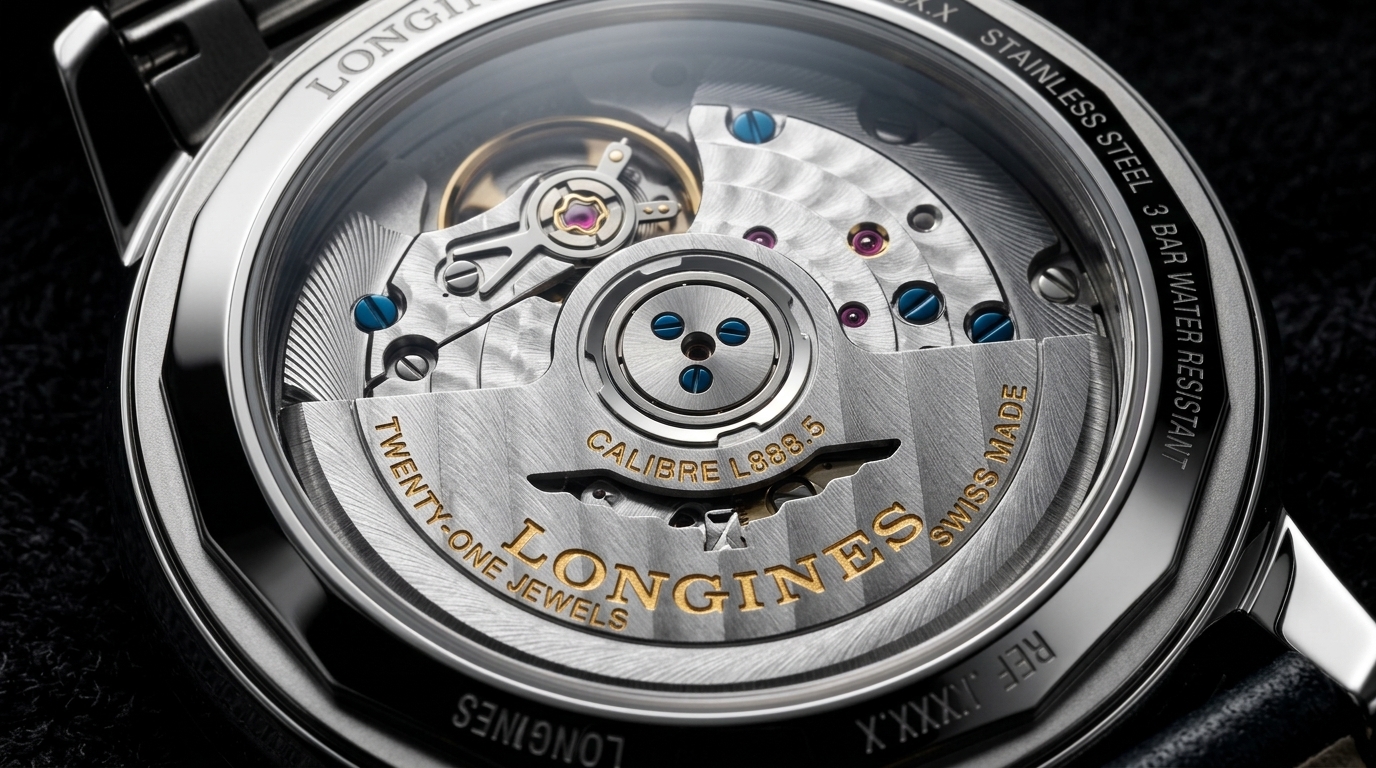
This is partly because Longines occupies a peculiar, perhaps enviable, position in Swiss watchmaking. It belongs to the Swatch Group, with access to industrial strength, movement development, and quality control that smaller independents can only envy. Its calibres are often based on ETA architecture, but they are not simply anonymous engines dropped into handsome shells. The L888, derived from the 2892 family, runs at a reduced frequency of 25,200 vibrations per hour and offers a power reserve around three days. Variants include silicon balance springs and antimagnetic improvements. The L844 in the Spirit Zulu Time gives a true GMT mechanism, allowing the local hour hand to jump independently, a practical feature for travel rather than a graphic flourish. The L688 chronograph movement, related to the Valjoux 7753 but reworked with a column wheel, gives Longines an unusually refined automatic chronograph proposition at its level.
These details deserve mention not because they win an argument, but because they support the larger impression of competence. Longines is not making watches for those who need every bridge to be black-polished into philosophical significance. Nor is it making disposable nostalgia. Its movements are finished in the industrial Swiss manner: clean, regular, sometimes decorated with perlage or striping, more concerned with correctness than spectacle. The rotor may bear the winged hourglass. The screws sit properly. The tolerances are respectable. The casebacks, when transparent, reveal a machine that has no wish to be mistaken for Geneva’s most theatrical hand-finished calibres. It is, instead, honest about its station.
The word “station” may sound old-fashioned, but Longines is an old-fashioned pleasure in the best sense. It understands dress without costume. The DolceVita line, with its rectangular case and Art Deco inflection, could easily have descended into mannerism, yet its better executions have a civility of line that recalls an era when sharp edges and polished surfaces could suggest evening clothes without imitating them. Likewise the Evidenza, tonneau-shaped and slightly eccentric, speaks in curved metal rather than volume. These watches do not demand that the owner be extraordinary. They ask only that the ordinary day be given better manners.
The Master Collection is perhaps where the Longines temperament becomes most visible. Moonphases, chronographs, annual calendars, power reserve indications, textured dials, Roman numerals, leaf hands: the collection can appear dense, even crowded, when viewed as a whole. Yet within it are pieces that reveal the brand’s central gift. A full calendar moonphase in stainless steel, with blued hands and a silver barleycorn dial, carries a complication historically associated with much more costly watchmaking, but Longines presents it not as an altar object. It remains a watch for appointments, dinners, train platforms, winter sleeves. The moon disc turns its slow theatre at six, the day and month sit in apertures, the pointer date makes its circuit. There is poetry, yes, but the poetry keeps office hours.
That may be why Longines so often appeals to people who do not want their watches to behave like acquisitions. There is a difference between possessing a luxury object and simply living with a well-made thing. The former asks to be noticed; the latter improves the weather in a private way. Longines tends toward the second condition. Even its more assertive modern sports watches, such as the HydroConquest or Spirit collection, retain a certain cleanliness. The Spirit line in particular draws on aviation history without dressing itself in theatrical patina. Applied Arabic numerals, strong lume, a sturdy case, and the five stars on the dial: these elements could have been overplayed. Instead, in the better sizes and colors, they settle into a practical rhythm.
The five stars deserve a moment because they are a small risk. On another dial, such symbolism might feel like a hotel rating or a boast pulled from a catalogue. On Longines, the stars recall a historical grading language the brand used for movement quality, and they sit there with mild formality. They do not pretend the watch has landed an aircraft or crossed an ocean. They suggest instead that Longines knows its own archive well enough to borrow from it without turning memory into masquerade.
Aviation, of course, is part of the Longines story in a way that cannot be faked. The Hour Angle watch, developed with Charles Lindbergh after his 1927 transatlantic flight, remains one of the strangest and most purposeful designs to have entered the canon. Its rotating bezel and dial system allowed pilots to calculate longitude in conjunction with a sextant and nautical almanac. Beauty, in that case, was almost accidental, born of function layered upon function until the face of the watch became a navigational instrument. The modern reissues cannot recreate the loneliness of early flight, the cold cockpit, the mathematical urgency, but they preserve the idea that a wristwatch once helped locate a human being in blank air above an indifferent sea.
Longines’ relationship with winning becomes more interesting in this light. The brand has stood at finish lines and beside runways; it has measured the decisive fractions by which one horse, skier, or rider defeats another. But the watch itself is rarely the victor. It is the witness. It records without exulting. It gives the time, captures the interval, confirms the result. There is dignity in that secondary role, and Longines has made a house style from it. The elegance is not that of being crowned, but of keeping the minutes accurately while crowns are handed out elsewhere.
This may be why Longines suits an age exhausted by display. The watch market has become fluent in scarcity, queues, premiums, color drops, celebrity wrists, and immediate resale arithmetic. In that weather, a Longines can feel almost radical by remaining available, legible, and fairly priced in relation to its substance. Availability is not usually treated as a virtue in luxury, but perhaps it should be. A watch that can be bought without theatrics is not necessarily less desirable. It may simply be less infected by performance. Longines does not ask the buyer to win permission to own it.
That absence of gatekeeping has sometimes caused connoisseurs to underestimate the brand. Prestige, in watches, is often confused with difficulty: difficulty of acquisition, difficulty of servicing, difficulty of explaining the price. Longines is not difficult in that sense. Its catalogues are printed in broad circulation. Its boutiques are approachable. Its movements can be understood without priestly initiation. But simplicity of access should not be mistaken for thinness of meaning. The archive is deep. The design language, when disciplined, is graceful. The technical base is sound. The brand has chosen breadth over mystique, and though breadth brings unevenness, it also keeps the watches close to ordinary life.
There is something particularly Swiss in this balance between romance and administration. The polished case and the regulated calibre; the cavalry officer and the warranty card; the moonphase and the service interval. Longines knows that mechanical watchmaking now survives partly as emotion, partly as ritual, and partly as engineering theatre made wearable. Yet it does not collapse into fantasy. The best Longines watches continue to look as if they understand bank counters, passport desks, restaurant tables, and late trains. They belong to the world in which time is both measured and felt.
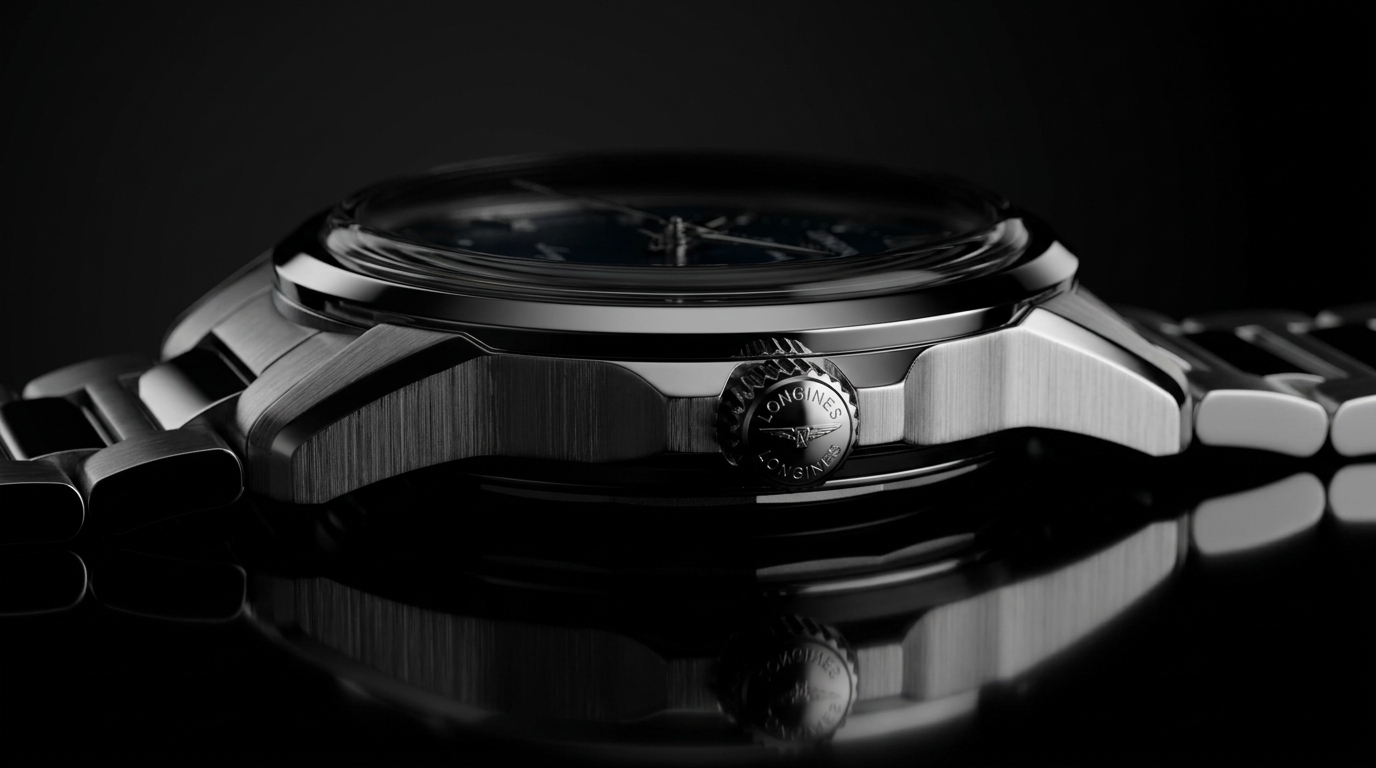
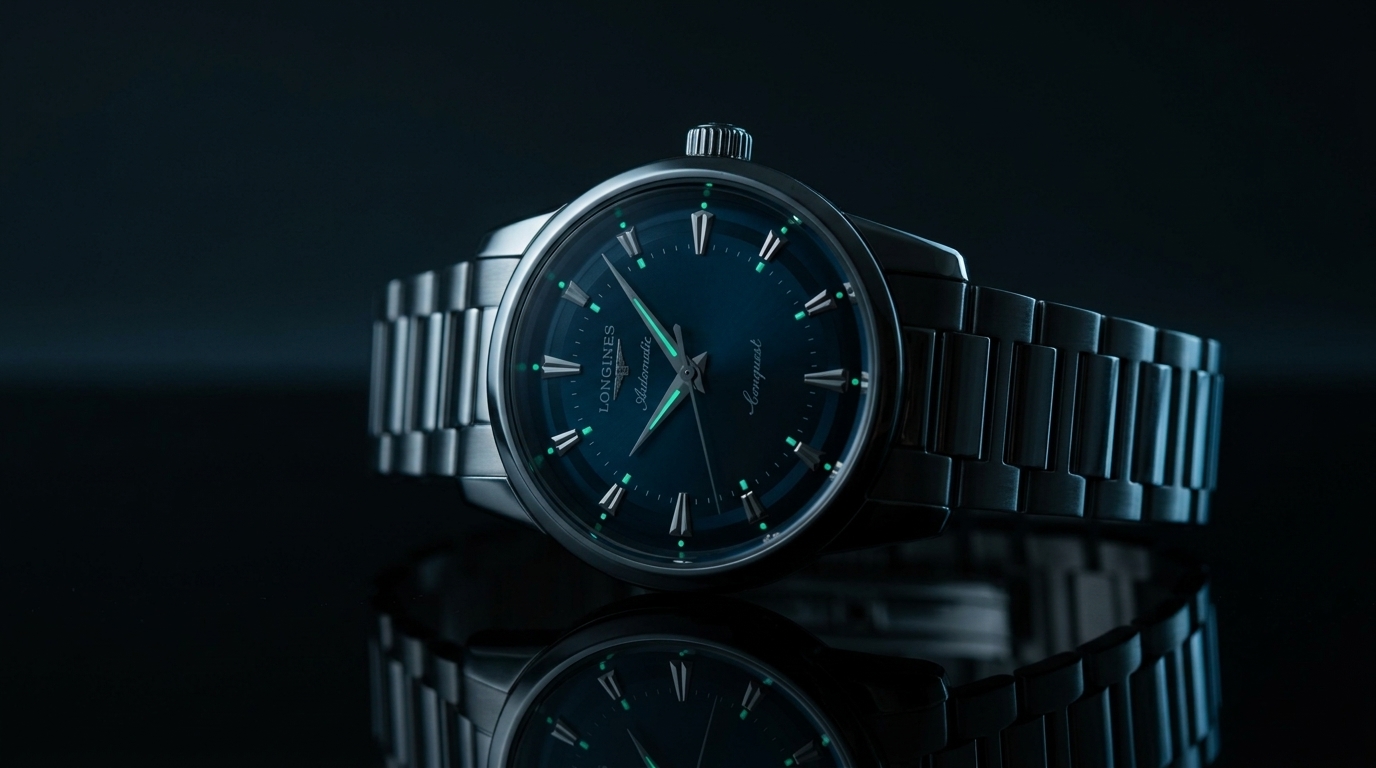
The finishing of a Longines case is rarely the subject of feverish loupe photography, yet it often rewards ordinary sight. A bevel along a lug, a polished chamfer against a brushed surface, the clean seating of a sapphire crystal, the restraint of a signed crown: these are modest satisfactions. The dials, too, can be very fine at their level, especially when Longines allows texture to breathe. A sunburst blue dial can turn from ink to steel as the wrist moves. A silver dial with printed black numerals can feel almost architectural. Applied indices give small shadows. Leaf hands soften a formal face without making it precious. None of these things is revolutionary. Their power lies in being correctly judged.
Correct judgment has always been rarer than invention. Many watches offer novelty; fewer offer composure. Longines’ failures, when they occur, often come from forgetting this and trying to satisfy too many imagined customers at once: a date squeezed onto a reissue that did not need one, a case enlarged beyond the memory it invokes, a dial given one line too many. But those missteps underline the strength of the successful pieces. When Longines edits itself, the result can be quietly devastating. Not because it dazzles, but because it seems inevitable.
The elegance of not needing to win is not the same as indifference to excellence. It is, rather, excellence relieved of anxiety. A Longines chronograph with a column wheel does not have to defeat a haute horlogerie chronograph to be meaningful. A Spirit Zulu Time does not have to dominate every travel watch comparison to be useful and handsome. A Heritage Classic does not need to become the most discussed watch of the season to justify the care in its proportions. These objects exist in a calmer register, where the question is not whether the watch can conquer a category, but whether it can remain satisfying after comparison has lost its heat.
In the end, Longines’ peculiar grace lies in its acceptance of being neither obscure nor untouchable. It is famous, but not fevered. Historical, but not trapped. Industrial, but not careless. Elegant, but not fragile. It can make a watch for a pilot, a pianist, a rider, a clerk, a collector, and a person buying one good mechanical watch to mark a private threshold. It does not require the mythology of victory because it has another mythology available: continuity. The winged hourglass is a perfect emblem for this. Wings imply motion, ambition, escape; the hourglass suggests patience, gravity, loss. Held together, they describe a watchmaker that has spent more than a century measuring movement without being consumed by speed.
At 10:10, the hands remain where watch photography likes them, framing the name with polite symmetry. But beyond the pose there is a deeper stillness. Longines does not appear to be asking for applause. It has timed applause before. It knows how brief it is. The case will gather small marks, the strap will curve, the movement will require service one day, and the dial will continue its daily act of making order visible. That is enough. In a culture so often obsessed with the podium, Longines offers the quieter pleasure of the timekeeper: present at the decisive moment, precise in its duty, and free from the need to stand above anyone when the result is announced.