Rolex: The Industrial Strategy Behind the World’s Most Important Watch Brand

Rolex: The Industrial Strategy Behind the World’s Most Important Watch Brand
The most important Rolex complication is not the chronograph, the GMT hand, or the annual calendar. It is allocation. No other mechanical watch company has turned consistency, controlled supply, distribution discipline, and incremental technical change into a stronger commercial machine. Rolex is often discussed as if it were simply a maker of Submariners, Daytonas, and Datejusts. That is too narrow. Rolex is the most consequential industrial system in modern watchmaking, and its watches are best understood as outputs of that system rather than isolated objects of enthusiasm.
This is not a romantic reading of the Crown. Rolex does not need romance. The company’s strength lies in its refusal to behave like most of the Swiss watch industry. It avoids flamboyant complications, limits public communication, rarely explains itself, and allows demand to accumulate outside the boutique window. The result is a brand whose desirability is supported less by novelty than by institutional confidence: buyers believe a Rolex will be legible, durable, serviceable, recognisable, and financially resilient. In the luxury watch market, that combination is more powerful than artistic complexity.
From Wilsdorf’s Bet to Geneva’s Most Controlled Institution
Rolex began not in Switzerland, but in London. Hans Wilsdorf and Alfred Davis founded Wilsdorf & Davis in 1905, importing Swiss movements and casing watches for the British market. Wilsdorf registered the Rolex name in 1908, reportedly favouring a short word that could be pronounced across languages and fitted cleanly on a dial. The company moved its operational centre to Geneva after the First World War, with Montres Rolex S.A. registered in 1920. That early geography matters: Rolex was international before it was conventionally Swiss.
Wilsdorf’s central insight was that wristwatches could become serious instruments if the public trusted their precision and resilience. In 1910, a Rolex wristwatch received a chronometer certificate from the Official Watch Rating Centre in Bienne. In 1914, Kew Observatory awarded a Rolex wristwatch a Class A precision certificate, a category more commonly associated with marine chronometers. These episodes are not mere archive decoration; they formed the template for a century of Rolex messaging. Accuracy first, then waterproofness, then professional utility, all wrapped in a conservative exterior.
The Oyster case, patented in 1926, gave Rolex its defining technical and commercial platform. The screw-down bezel, caseback, and crown created a water-resistant architecture that could be communicated simply. Mercedes Gleitze’s 1927 English Channel swim, promoted by Rolex after she wore an Oyster during the attempt, established the brand’s enduring method: attach a technical claim to a public test, then repeat the message until it becomes common knowledge. The perpetual rotor automatic system, introduced in the early 1930s, completed the foundation. Rolex’s core proposition has been remarkably stable since then: sealed case, automatic movement, tested precision.
The Product Philosophy: Incrementalism as Discipline
Rolex is often criticised for changing too little. That criticism misunderstands the strategy. The company changes almost nothing until it can change everything that matters underneath. A Submariner may look broadly continuous from the reference 5513 of the 1960s to the current 124060, but the watch has moved through substantial changes in metallurgy, bracelet construction, movement architecture, luminous material, water-resistance execution, and manufacturing tolerance. Rolex’s genius is to make technical change feel visually inevitable rather than disruptive.
The Submariner is the clearest case study. The reference 6204 appeared in 1953, followed by a long series of tool-watch iterations: crown guards on the 5512 and 5513, date display on the 1680 in the late 1960s, sapphire crystal and increased refinement on the 16800 and 16610, ceramic Cerachrom bezel on the 116610LN in 2010, and the broader 41 mm generation with calibre 3230 or 3235 in 2020. Collectors debate lug geometry and dial text because those details are where Rolex permits visible evolution. The underlying direction is less debatable: less vulnerability, more precision, better bracelets, longer service intervals, tighter industrial control.
The same applies to the GMT-Master. Designed in the 1950s for Pan Am pilots, the model’s logic was practical: a rotating 24-hour bezel and an additional hand for tracking another time zone. The modern GMT-Master II, particularly references such as the 126710BLRO and 126710BLNR, is no longer primarily a pilot’s instrument, but its functional grammar remains intact. The calibre 3285, with Chronergy escapement and roughly 70 hours of power reserve, demonstrates Rolex’s preferred kind of innovation: measurable, useful, and almost invisible to a casual observer.

Movements: Conservative Engineering, Not Decorative Watchmaking
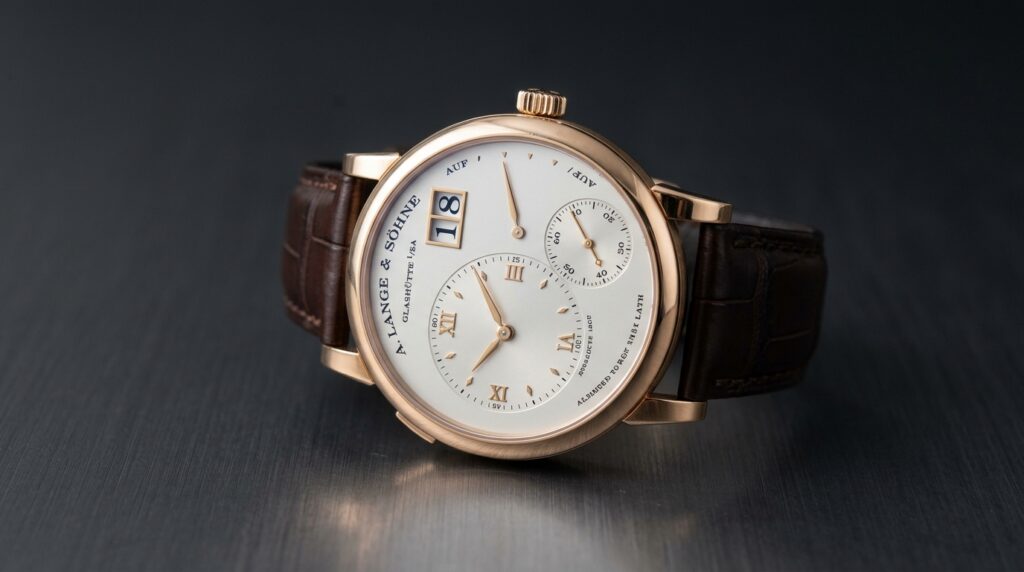
Rolex does not make movements to impress through finishing. It makes them to run. The distinction is important. A Lange calibre or a high-grade Patek Philippe movement invites inspection under a loupe; Rolex calibres are engineered for amplitude stability, shock resistance, serviceability, and repeatable production. The 3135, introduced in 1988 and used for decades across Datejust, Submariner Date, Sea-Dweller, and other models, became one of the most trusted automatic movements of the late twentieth century. It was not exotic, but it was robust and widely understood by trained watchmakers.
The current 32xx family, including the 3230, 3235, and 3285, brought a longer power reserve, high-efficiency Chronergy escapement, Parachrom hairspring, and Rolex’s Superlative Chronometer standard of -2/+2 seconds per day after casing. That final phrase matters: Rolex tests the complete watch, not merely the bare movement certified by COSC. The brand’s own standard is stricter than COSC’s -4/+6 seconds per day range. This is not haute horlogerie in the Geneva Seal sense. It is industrial precision applied at scale.
The Daytona’s movement history shows Rolex’s approach with unusual clarity. The manually wound Daytona references, including the 6239 and 6263, used Valjoux-based calibres and were commercially slow sellers during parts of their original production life. The automatic reference 16520, launched in 1988, used the Zenith El Primero-based calibre 4030, heavily modified by Rolex. In 2000, the reference 116520 introduced the in-house calibre 4130, a cleaner, more efficient chronograph movement with a vertical clutch and column wheel. In 2023, the reference 126500LN arrived with calibre 4131, revising the architecture and finishing while preserving the Daytona’s essential proportions. The lesson is consistent: Rolex moves when it can make the industrial case, not when fashion demands it.

Design as Controlled Recognition
Rolex design is frequently described as timeless, but that word is imprecise. The better term is controlled recognition. A Datejust, Submariner, Day-Date, GMT-Master II, Explorer, and Daytona can be identified across a room because Rolex treats design codes as assets to be managed, not canvases to be reinvented. The fluted bezel, Jubilee bracelet, Oyster bracelet, Mercedes handset, Cyclops lens, and professional bezel formats are part of a visual system with unusually high public literacy.
The Datejust may be Rolex’s most important watch, despite the cultural dominance of the Submariner and Daytona. Introduced in 1945 for the company’s 40th anniversary, it established the automatic date-changing wristwatch as a luxury daily wearer. Modern references such as the 126200, 126234, 126300, and 126334 show how carefully Rolex manages breadth: steel, steel and white gold, smooth bezel, fluted bezel, Oyster bracelet, Jubilee bracelet, 36 mm and 41 mm cases. The Datejust is not one watch; it is a distribution architecture for taste, status, and budget.
The Day-Date, launched in 1956 and long associated with precious metal cases, occupies a different role. It is Rolex’s clearest status object: inherently less tool-like, more political, more ceremonial. References from vintage 1803 examples to modern 228238 models in yellow gold show continuity in both concept and audience. The “President” bracelet did not become shorthand for power by accident. It became shorthand because Rolex kept the Day-Date expensive, legible, and institutionally associated with leadership rather than seasonal style.

Scarcity, Retail Control, and the Modern Rolex Market
The contemporary Rolex market cannot be assessed honestly without discussing scarcity. Authorised dealers have, for years, been unable or unwilling to supply the most demanded steel professional references on request. The Submariner 124060, GMT-Master II 126710BLRO, and Daytona 126500LN are not obscure pieces, yet access to them at retail is heavily mediated by dealer relationships, purchase history, local demand, and brand governance. Rolex does not officially describe this as artificial scarcity. It does not need to. The market experiences it as scarcity regardless of intent.
The secondary market turned that scarcity into an asset bubble during 2020–2022. Steel Daytonas, GMTs, and Submariners traded at premiums far above retail, accelerated by low interest rates, lockdown-era collecting, cryptocurrency wealth, and speculative watch platforms. By 2023 and 2024, prices corrected materially from the peaks, especially for recently produced references bought at inflated levels. The important point is not that Rolex was immune to the correction; it was not. The important point is that Rolex remained more liquid than almost any other mechanical watch brand. Liquidity is a form of brand power collectors often underestimate until they need to sell.
Rolex’s Certified Pre-Owned programme, launched in 2022 through Bucherer before expanding to other authorised channels, was a strategic acknowledgment that the brand could no longer ignore the pre-owned market. The 2023 acquisition of Bucherer by Rolex was more significant still. Bucherer, founded in 1888 and one of the world’s most important watch retailers, gave Rolex direct ownership exposure to retail at a scale it had historically avoided. Rolex insisted Bucherer would remain independently operated, but the strategic implication is clear: the Crown wants better visibility over the full customer journey, including resale, certification, and retail presentation.

Ownership and Independence: The Hans Wilsdorf Foundation Advantage
Rolex is not owned by a listed luxury conglomerate. Since Hans Wilsdorf’s death in 1960, the company has been controlled by the Hans Wilsdorf Foundation. This ownership structure is central to understanding the brand. Rolex does not report quarterly earnings to public shareholders, does not need to chase fashion cycles to satisfy a group margin target, and does not publicly disclose production figures. Estimates commonly place annual Rolex output around or above one million watches, but the company does not confirm the figure. The opacity is not incidental; it is part of the operating model.
Foundation ownership gives Rolex strategic patience. It can fund manufacturing expansion, maintain conservative product cycles, and avoid the public pressure faced by brands inside LVMH, Richemont, or Swatch Group. This does not make Rolex altruistic, nor does it make its retail experience universally fair. It simply gives the company different incentives. Rolex can prioritise long-term brand equity over short-term volume disclosure. In a market where many brands overproduce into discount channels, that discipline is a structural advantage.
Vertical integration reinforces the point. Rolex operates major facilities in Geneva, Bienne, Plan-les-Ouates, and Chêne-Bourg, covering movement production, cases, bracelets, dials, gem-setting, and research. The company’s use of 904L steel, now branded Oystersteel, is often overstated in consumer discussions, but it does reflect Rolex’s willingness to industrialise specific material choices at scale. Its proprietary gold foundry and ceramic bezel production are not romantic claims; they are mechanisms of control. Rolex reduces vendor dependency because consistency is the business.
The Collector’s Paradox
For collectors, Rolex creates a paradox. The brand is both obvious and difficult. It is obvious because certain references are almost universally known: Submariner, Daytona, GMT-Master II, Explorer, Datejust, Day-Date. It is difficult because the meaningful distinctions often lie in production details, dial variants, bracelet references, case condition, service history, and originality. A vintage Submariner 5513 with a correct matte dial and strong case is a different asset from a polished example with service parts, even if both are “the same watch” to a casual buyer.
The vintage market has long rewarded nuance. Paul Newman-dial Daytonas, gilt-dial Submariners, double-red Sea-Dwellers, and early GMT-Masters have produced some of the most public auction results in watch collecting. Yet the modern Rolex collector faces a different game. Current references are produced in larger numbers, documented more thoroughly, and traded more transparently. Their premiums depend less on rarity in the absolute sense and more on access, condition, completeness, and immediate desirability. A sealed or unworn modern Rolex may attract attention, but it is not rare in the same way a well-preserved 1960s gilt 1675 is rare.
This is where editorial caution is needed. Rolex is not always the most interesting watch you can buy for the money. A Grand Seiko can offer more dial craft, an Omega Speedmaster Professional more accessible chronograph heritage, a Jaeger-LeCoultre more traditional movement culture, and an independent maker more horological personality. But Rolex offers something those alternatives rarely match together: recognisability, durability, service infrastructure, and market depth. That combination explains the price behaviour more convincingly than mythology does.

Why Rolex Still Sets the Terms
Rolex’s dominance is not accidental, and it is not solely the result of advertising. The brand built its authority through a narrow set of claims and then defended them for more than a century: accurate automatic watches, water-resistant cases, disciplined design, strong bracelets, controlled distribution, and recognisable model families. Its weaknesses are real. Retail access can be opaque. Product conservatism can border on stubbornness. The brand’s cultural ubiquity can make ownership feel less personal than collectors might prefer. None of that changes the strategic fact that Rolex remains the benchmark against which the broader market prices trust.
The Crown’s greatest achievement is that it has made reliability aspirational. That is harder than making complexity impressive. Complications can be displayed; confidence has to be earned repeatedly, through servicing outcomes, daily use, resale behaviour, and decades of recognisable continuity. Rolex does not win every horological argument. It does not need to. It wins the argument that matters most to the largest number of serious buyers: if one mechanical watch has to carry financial, social, and practical weight at the same time, Rolex is still the safest answer.
That safety is not dull. It is the product of unusually severe discipline. In an industry prone to anniversaries, limited editions, ambassador theatrics, and aesthetic overcorrection, Rolex behaves more like a central bank than a fashion house. It manages confidence, restricts unnecessary volatility, and lets the market do much of the talking. Collectors may resent the waitlists, question the premiums, or prefer more expressive watchmaking. Still, every year, the same question returns with uncomfortable force: how many brands would be stronger if they had changed less, controlled more, and understood the value of trust as ruthlessly as Rolex?