H. Moser & Cie.: The Luxury Watchmaker Turning Minimalism Into a Modern Power Move
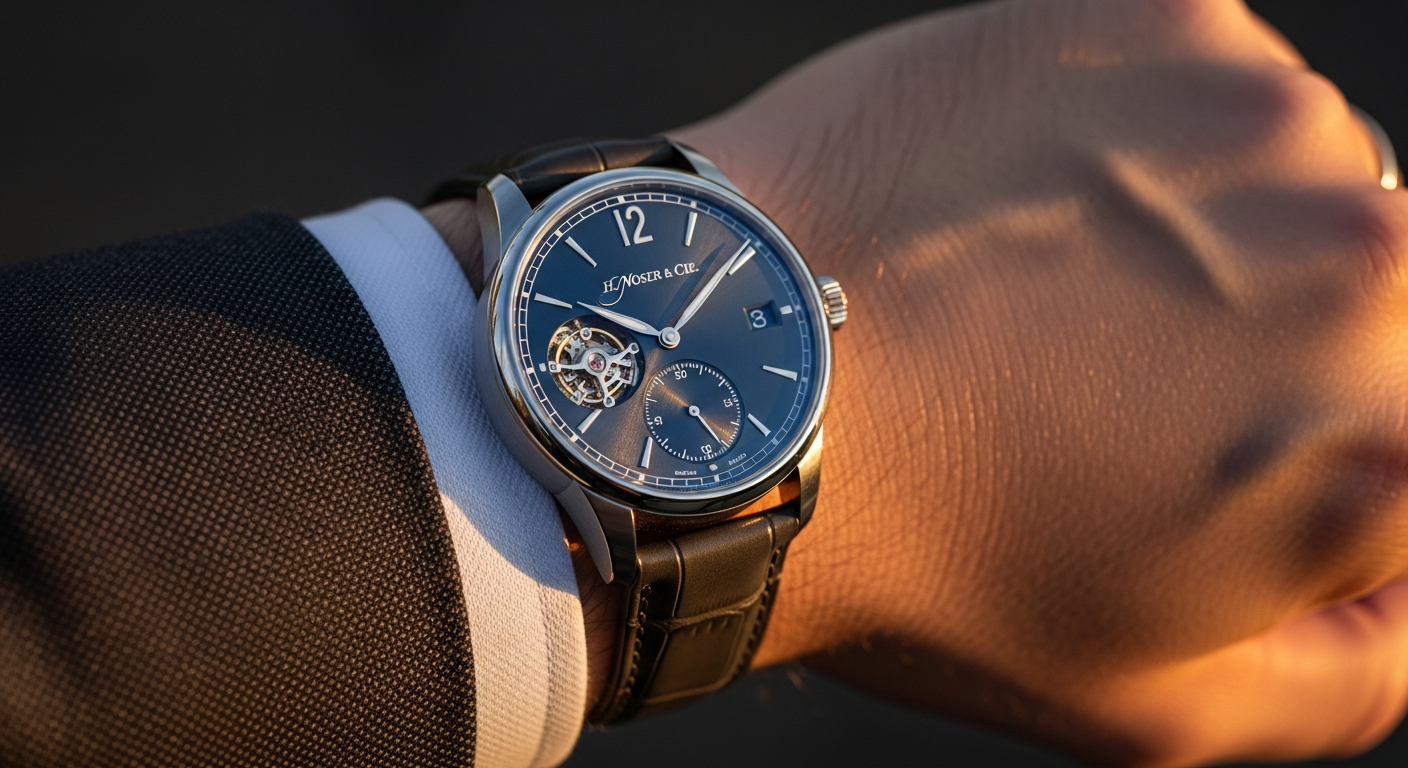
In an industry where luxury often shouts—through heritage slogans, aggressive branding, and instantly recognizable silhouettes—H. Moser & Cie. whispers. A near-empty dial, a saturated fumé gradient, and a movement finished like a manifesto: Moser’s strategy is to remove everything that doesn’t earn its place, then charge more attention for what remains. The result is a modern independent that feels less like a “brand” and more like a point of view—one that collectors increasingly treat as a signal of taste rather than status-seeking conformity, and one that quietly rewires what contemporary luxury can look like on the wrist and in the culture around it.
This is the thesis: Moser isn’t merely designing watches—it’s designing a counter-language for high horology, where restraint, transparency, and selective provocation become the ultimate differentiators in a saturated luxury market.
From the Streamliner’s fluid modernity to the Endeavour’s pared-back elegance, and from the brand’s in-house movements (and hairspring capability) to its outspoken brand theater, Moser has built a playbook that many admire but few can replicate.
The question isn’t whether the watches are good. It’s why this specific mix of minimalism, mechanics, and mischief is so effective right now—and what it reveals about where luxury watch culture is headed.
This article unpacks the Moser method: how the brand turns fewer words into more meaning, how it defends its independence through real industrial capability, and how it uses controversy not as shock but as clarity—cutting through the noise without becoming part of it.
By the end, you’ll see H. Moser & Cie. not as an outlier, but as one of the most strategically coherent brands in modern watchmaking—and a case study in how to build desire in the post-logo era.
And yes: it all starts with a dial that often refuses to tell you who made it.
Let’s begin with the most radical thing Moser does: it dares you to recognize quality without being told what to think.
That’s the real luxury move in 2026.
The Dial as Strategy, Not Styling
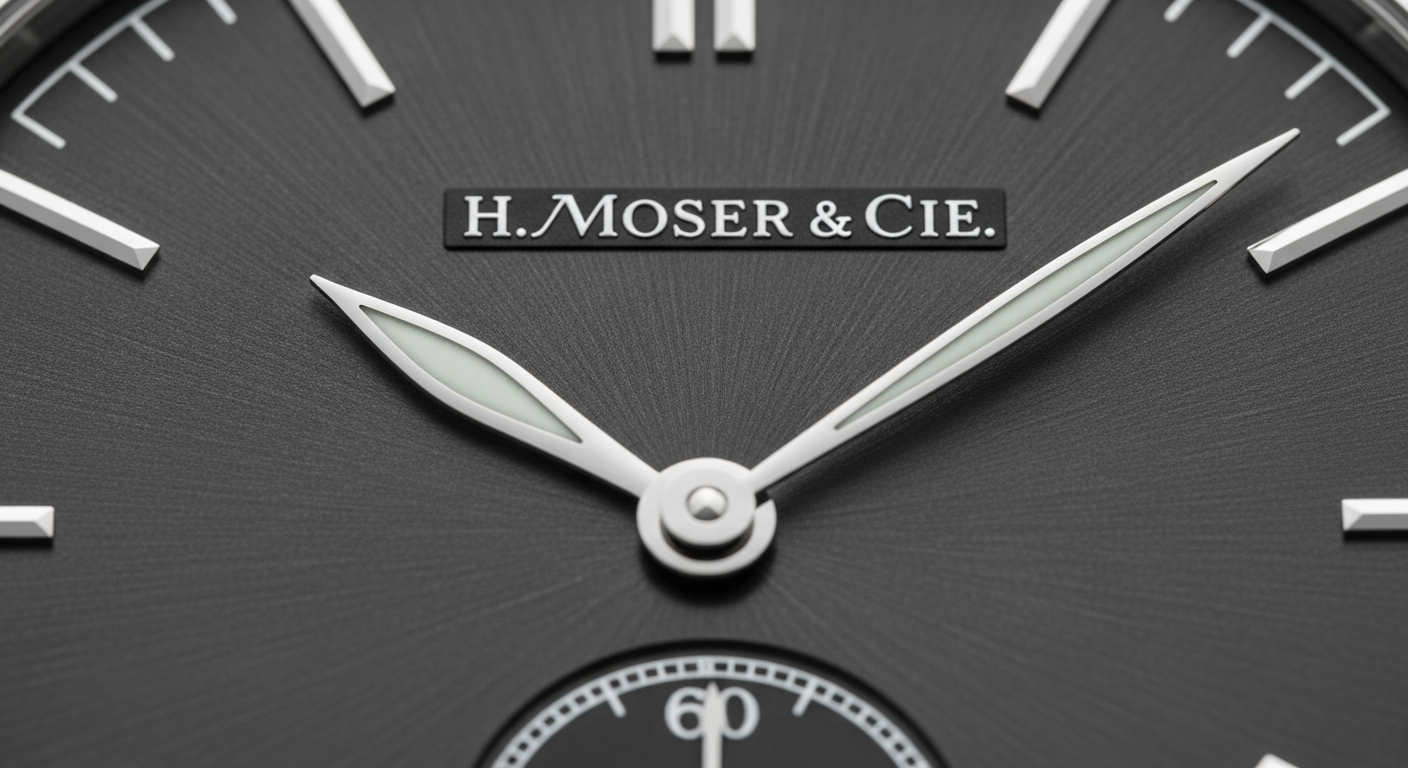
Most luxury watches use the dial as a billboard. At minimum you get a brand name, model line, “Swiss Made,” and a handful of decorative signifiers meant to reassure the buyer that they purchased the correct kind of expensive. Moser goes the other way. Its most recognizable modern move is subtraction: no logo, no text, no apology. The dial becomes a test of visual literacy rather than an assertion of identity.
This is not minimalism as austerity. It’s minimalism as control. A Moser fumé dial is rarely plain; it’s saturated, lacquered, and intentionally moody—color that drifts from center to edge like a lens filter. The effect is not “simple” so much as singular: the dial offers just enough information to tell time, then uses the remaining surface as a field for texture and depth. When the brand does add elements—applied indices, a power reserve, a small seconds—it tends to do so with a sense of necessity rather than decoration.
Strategically, that restraint performs two jobs at once. First, it makes the watch legible as a Moser from across a table without resorting to the usual tropes of bezel shapes, celebrity endorsements, or signature patterns. Second, it creates a collector-facing value proposition: recognition without instruction. In a market where the loudest objects are often the easiest to sell, Moser’s dial implies that the buyer doesn’t need help explaining themselves.
The “Concept” dials sharpen that implication into a positioning statement. A logo-free dial doesn’t just look modern; it rejects a core assumption of luxury marketing, which is that status must be made obvious to be effective. Moser’s answer is that status is not the point. Discernment is. That idea lands especially well now, as collectors increasingly separate “high price” from “high taste,” and seek watches that reward long ownership rather than quick recognition.
Streamliner and Endeavour: Two Faces of the Same Thesis
It’s tempting to describe Moser as a one-trick brand with a particularly photogenic dial treatment. The better reading is that Moser has built two primary design languages—Streamliner and Endeavour—that express the same philosophy through different cultural references.
The Endeavour is Moser’s purest platform for reduction. It carries the brand’s elegant casework, long lugs, and formal proportions, but avoids nostalgia. In an era when many “dress watches” function as retro-fetish objects, the Endeavour reads like a contemporary product: clean geometry, measured polishing, and dials that behave like color theory experiments. The minimalism here is architectural. It frames the movement as the real luxury, with the dial acting as a quiet stage.
The Streamliner, by contrast, is where Moser proves that modern can be sensual. The integrated bracelet is not the usual angular homage; it’s fluid, rounded, almost biomorphic. The case and bracelet flow as one object rather than a head attached to a strap. It’s sporty without the typical aggression—no exposed screws, no faux-industrial posturing. This is important: it gives Moser access to the contemporary luxury sports watch conversation while avoiding the most exhausted visual clichés of the segment.
Despite their differences, both families share the same strategic spine. They are recognizably Moser without leaning on heritage iconography. They are “designed,” but not excessively designed. And crucially, they create a distinct silhouette in a crowded field without resorting to the shortcuts of a loud bezel or an overloaded dial. That is a harder path, but it’s one that ages better—and collectors notice.
Mechanics as Credibility: In-House, Vertical, and Unusually Serious
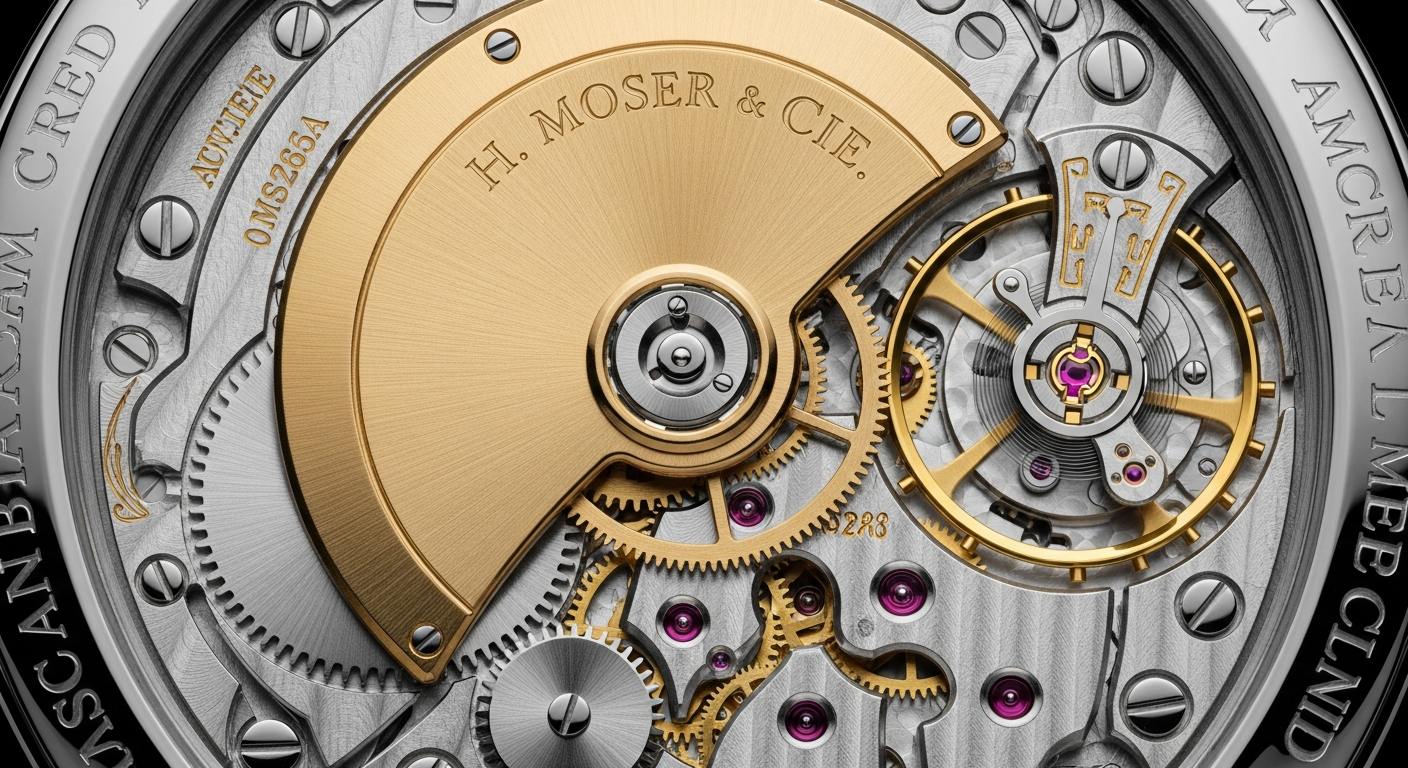
Minimalism on the outside only works if the inside can carry the weight. Moser understands this, and it’s why the brand’s industrial posture matters as much as its design. The watches succeed because the restraint doesn’t feel like cost-saving; it feels like editorial discipline backed by substance.
In practice, Moser’s credibility comes from the unglamorous, expensive parts of watchmaking: movement development, manufacturing control, and a willingness to invest in capabilities that many brands outsource while still marketing as “in-house.” The ability to produce hairsprings via its associated entities is more than trivia. In a supply chain that has become both politicized and fragile, hairspring access is a statement of independence. It signals a certain security of production and a seriousness about chronometry that goes beyond finishing for Instagram.
The finishing itself is also strategically aligned. Moser movements tend to avoid showy excess in favor of coherence: wide stripes, clean beveling, solid architecture, and a sense that everything belongs. Even when the brand plays with modern aesthetics—more openworked elements, contemporary bridge shapes—it still communicates that the movement is not an outsourced afterthought. That matters because Moser’s external minimalism removes distractions. When a dial refuses to entertain, the movement has to justify the entire object as luxury.
There’s another layer here: Moser’s pricing and positioning require the buyer to believe in the brand’s internal competence, not just its external styling. In the post-logo era, “trust” becomes part of the product. Moser earns that trust through tangible manufacturing depth, then uses it to support design choices that would feel empty from a less capable maker.
Selective Provocation: Brand Theater as Noise-Cutting, Not Noise-Making
Minimal dials and serious mechanics could still leave a brand invisible in a market that rewards constant novelty. Moser’s answer has been a type of brand theater that is unusually deliberate. The point is not to chase attention with endless collaborations or contrived scarcity drops. The point is to puncture the industry’s self-seriousness just enough to be heard, then return to making watches.
Moser’s provocations tend to function as critiques rather than stunts. They are often aimed at the industry’s marketing habits, its tendency to inflate meaning, or its dependence on recycled heritage. When the brand does something cheeky—whether through product naming, unusual materials, or pointed limited concepts—it usually has a clear thesis: that luxury can be honest, and that collectors deserve to be treated as adults.
This matters because modern collectors are inundated with content. Outrage cycles, hype watches, and algorithmic trends have compressed attention spans and reduced many launches to a momentary spike. Moser’s provocation strategy is more durable. It creates memory rather than just reach. It also reinforces the brand’s central positioning: restraint with teeth. The watches are quiet, but the point of view is not.
There’s a risk, of course. Provocation can become a crutch, and mischief can cheapen craft if it reads as desperation. Moser generally avoids that trap by keeping the core product consistent. The humor never replaces the engineering; it frames it. The result is a brand that can participate in the cultural conversation without turning its catalog into a series of punchlines.
Scarcity Done Properly: Small Production, High Specificity
“Scarcity” in watches has become a blunt instrument. Many brands manufacture scarcity through distribution games, artificial waitlists, and limited editions that feel more like promotional mechanics than product decisions. Moser’s scarcity is more structural. As a modern independent, it operates at a scale where production is naturally constrained, and the watches carry a level of finishing and manufacturing complexity that doesn’t lend itself to mass output.
That natural scarcity creates a different kind of desirability. It isn’t primarily about flipping; it’s about access to an object that feels authored. When you see a Moser in the wild, it doesn’t register as a “hit product” in the way certain mainstream references do. It registers as a choice. That distinction becomes a form of cultural capital among collectors who’ve moved beyond the consensus picks.
Equally important is Moser’s specificity. The brand doesn’t try to cover every category with minor variations. Instead, it chooses a few platforms and pushes them with discipline: dial colors that feel curated, complications that are integrated rather than stacked on, and case/bracelet designs that don’t need annual reinvention. This reduces the sense of churn. The watches feel like part of a coherent universe rather than an endless stream of market tests.
The strategic outcome is that Moser can charge for attention as much as for materials. The buyer is not only paying for steel, gold, or a movement; they’re paying for a position inside a smaller, more intentional narrative. In a market saturated with “must-haves,” Moser offers a “meant-to-have.” That difference is subtle, but it’s exactly where modern luxury is migrating.
Why It Works Now: Post-Logo Luxury and the Reputational Watch
The broader context matters. Luxury watch culture has shifted from private connoisseurship to public display and, now, toward something more complicated: reputational luxury. Collectors still enjoy recognition, but many are wary of looking like they bought a watch for the internet. The cultural temperature has changed. Loud branding reads less like confidence and more like compliance.
Moser fits this moment because it provides a vehicle for status that doesn’t look like status-chasing. The empty-dial discipline, the in-house seriousness, and the occasional pointed satire combine into a product that communicates taste through refusal: refusal to advertise, refusal to follow the standard design scripts, refusal to pretend that heritage alone is a substitute for contemporary relevance.
This is also why Moser is hard to copy. Other brands can remove logos. They can even imitate fumé dials. But without the mechanical credibility and the consistent point of view, the result often feels like a design trend rather than a brand strategy. Moser’s minimalism works because it is supported by competence and defended by a coherent worldview.
In 2026, the most persuasive luxury isn’t the loudest. It’s the most deliberate. H. Moser & Cie. has built a modern independent blueprint that treats restraint as strength, manufacturing depth as independence, and provocation as a tool for clarity rather than chaos. The watches don’t ask to be noticed. They ask to be understood.
And that may be the most modern power move of all: a luxury watch that assumes you already know what you’re looking at.