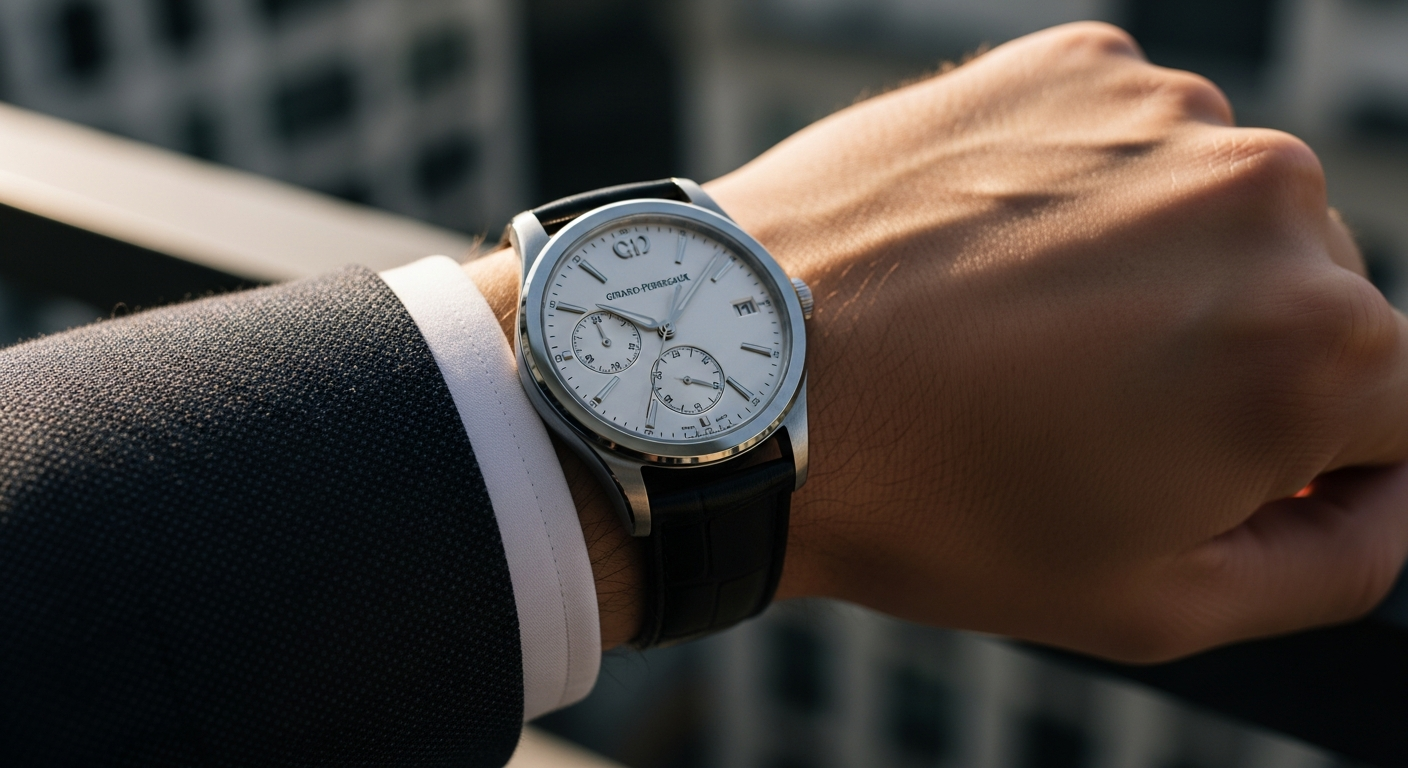
Girard-Perregaux Laureato and the Geometry of Confidence
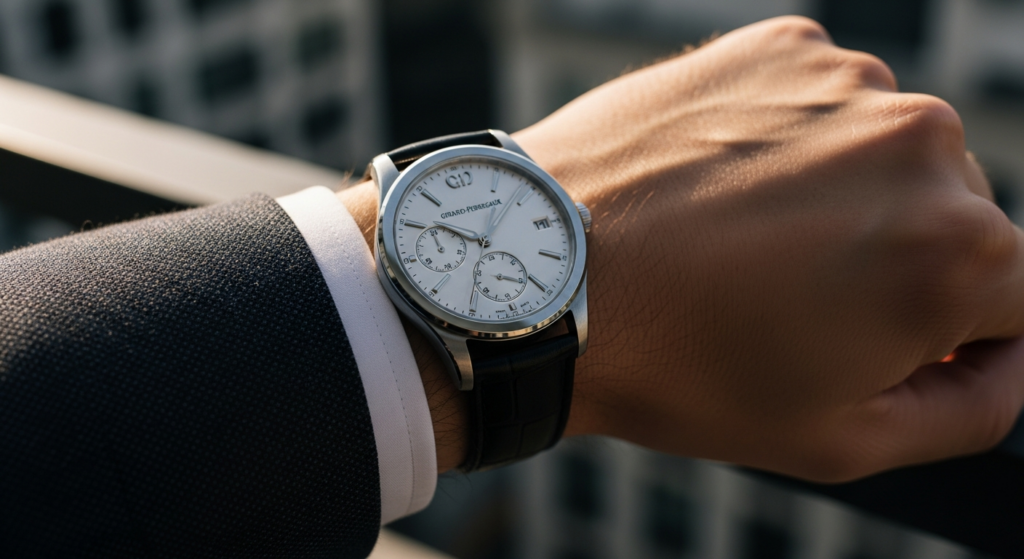
There are watches that announce themselves like a handshake held a second too long, and there are watches that enter a room the way a well-cut jacket does: quietly, decisively, without pleading for approval. The Girard-Perregaux Laureato belongs to the second category. It is not a watch that tries to convince you; it assumes you already know what you like. And if you don’t, it’s content to wait you out, letting shape and proportion do the persuading in their own time. The longer you spend with it, the clearer the sensation becomes that this isn’t merely a design you wear, but an attitude you borrow—an architecture of self-possession rendered in steel, gold, ceramic, or whatever material the moment demands.
Confidence is a slippery word in watchmaking. Brands often confuse it with volume: louder colors, larger cases, thicker bezels, busier dials, an endless parade of “statement” pieces. But real confidence rarely raises its voice. Real confidence is the disciplined act of choosing fewer lines and making each of them matter. In that sense, the Laureato has always been a kind of geometric manifesto: circles within octagons within circles, a layered conversation between curving grace and angular resolve. It’s a watch built from simple shapes arranged with such stubborn correctness that, once you’ve seen it, other designs can start to feel like they’re trying too hard.
The story starts, as good watch stories often do, with a decade that was both anxious and inventive. The 1970s, especially for Swiss watchmaking, were a period of existential discomfort. Quartz wasn’t just a technological competitor; it was a philosophical one, challenging the romance of gears with the efficiency of circuits. Brands had to decide what they were selling: timekeeping, or meaning. Girard-Perregaux, already a historic manufacture with deep roots, took the moment seriously and answered in a language that wasn’t purely nostalgic. The Laureato appeared as a confident synthesis of sportiness and refinement—one of those integrated-bracelet watches that treated the case and bracelet not as separate objects but as a single continuous piece of design, like a thought completed in one breath.
“Integrated” is a word that can sound clinical, but in practice it is emotional. An integrated bracelet changes the way a watch sits on the body; it dictates posture. It tends to feel less like a trinket perched on the wrist and more like a tool engineered for the human form. There’s a reason these watches, when executed well, feel so complete: they aren’t simply strapped on; they belong. With the Laureato, the integration is not merely structural. It’s visual theology. The case flows into the bracelet with a kind of inevitability, and that inevitability is where confidence lives. Nothing dangles. Nothing interrupts. Nothing asks for permission.
The Laureato’s geometry is often summarized as “octagonal bezel,” but that’s like describing a cathedral as “stone.” Yes, there is an octagon up top, but it is not the aggressive octagon of a stop sign. It’s an octagon softened by proportion and framed by a circle, like a strong opinion delivered with impeccable manners. The bezel’s edges catch light in small, controlled flashes; they don’t glare, they glint. And underneath, the case tends to present itself as a series of carefully finished planes, alternating between brushed surfaces that swallow reflections and polished accents that release them. This alternation becomes a visual rhythm, like measured breathing: take in, let out, take in, let out. It’s hard to look at the Laureato and not feel that the watch is, in some way, regulating the pace of the world around it.
But the most compelling thing about its geometry is how it flatters the wearer without flattering the ego. The Laureato doesn’t enlarge you or shrink you. It frames you. It’s a watch that understands negative space—the way the bezel holds the dial, the way the case holds the bezel, the way the bracelet holds the case. Everything carries everything else. That sense of being held is subtle, but it’s part of why people who are “not watch people” can still respond to it instinctively. Even without knowing a thing about calibers or history, they can feel when an object has been resolved.
There’s also a particular kind of maturity in the Laureato’s proportions. It often avoids the extremes that dominate trends: not too thick, not too loud, not too eager to prove it’s “sporty” with gratuitous bulk. Instead, it works like a piece of modernist furniture—functional, elegant, and more complex than it appears at first glance. The best designs don’t ask you to admire them; they simply keep rewarding your attention if you choose to give it.
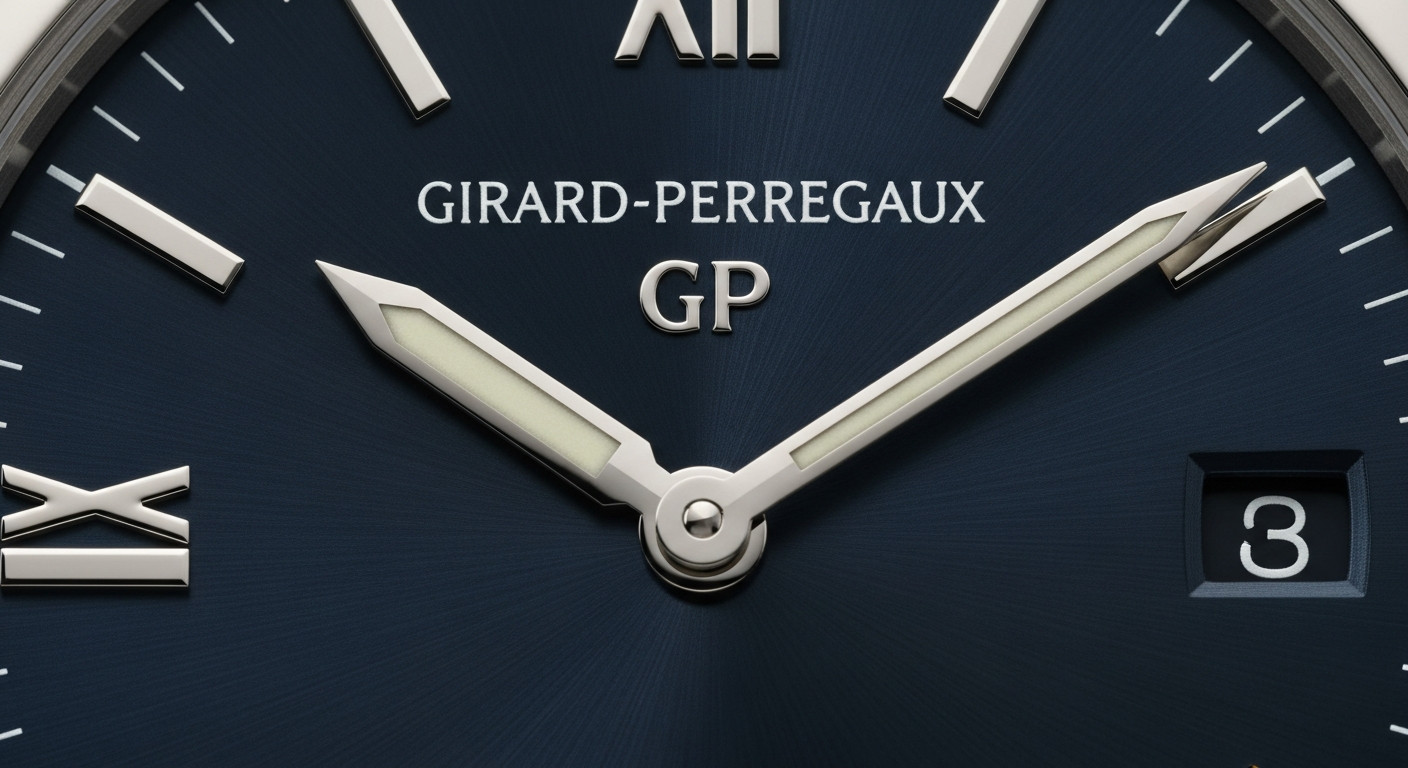
Then there’s the dial, where confidence becomes tactile. Many Laureato dials use a Clous de Paris hobnail pattern, a grid of small pyramids that turns light into texture. It’s a detail that behaves differently depending on the distance: from across the room it reads as a calm, matte field; up close it reveals itself as a landscape. That duality is important. A confident watch can afford to be modest at a glance because it knows it has something to say when you lean in. And that leaning in is part of the relationship. Watches are intimate objects. They live where pulse lives. A dial that rewards proximity feels like it was made with the owner in mind, not the crowd.
Wearing a Laureato for the first time can be an odd experience if you’re used to watches that perform. It doesn’t perform. It doesn’t try to dominate your outfit or become the conversation. It complements with a certain calm authority, the way a person with real expertise doesn’t need to recite their résumé. The watch’s lines do the talking: the crispness of the bezel, the way the bracelet articulates, the cleanliness of the case profile. If you’ve ever watched a tailor pinch fabric, making a sleeve fall perfectly, you know the feeling. It’s not drama. It’s correctness. And correctness, in a world of noise, can feel radical.
There’s a particular scene that plays out in the lives of many owners of integrated-bracelet watches. It happens on a weekday, not a weekend. You’re not dressed for an event; you’re dressed for the day. The watch goes on almost automatically, and later, in an elevator mirror or at a café table, you catch a glimpse of it catching light. For a second, you register yourself as more composed than you felt five minutes ago. Nothing has changed—except the reminder of order at your wrist. The Laureato does that. It doesn’t grant confidence like a magic charm, but it reflects it back at you when you forget it’s there.
This is where its geometry becomes more than aesthetics. Geometry, after all, is the human desire to make sense of space. It is a promise that the world is describable, that chaos can be mapped. When a watch leans into geometry, it’s leaning into that promise. The Laureato’s circle-octagon-circle arrangement feels like a small, wearable assertion that structure is possible. That you can be both flexible and firm. That you can move through the day with edges and curves, with boundaries and openness. Not a bad mantra to wear.
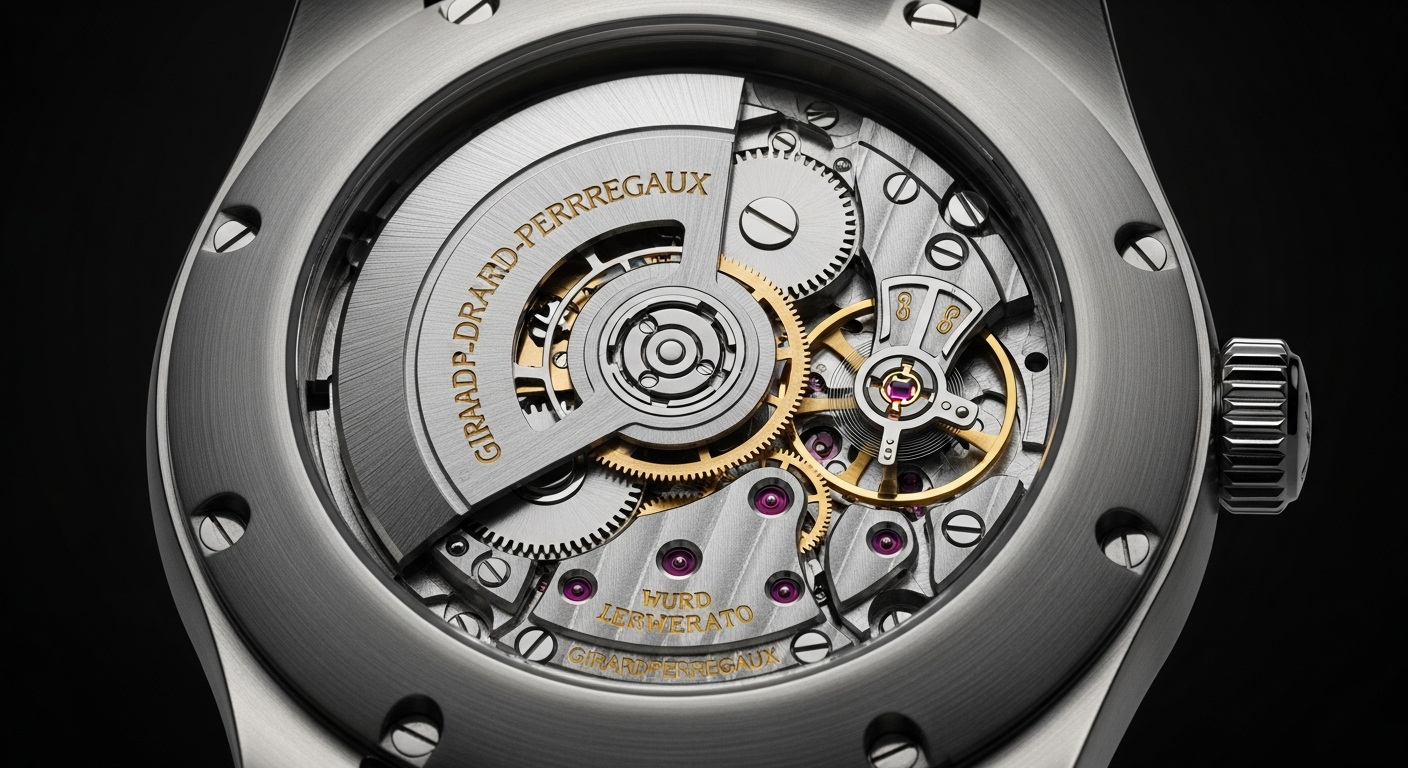
Of course, confidence in watchmaking also comes from what you don’t see. Girard-Perregaux is not a brand that relies on outsourced identity; it has long operated as a manufacture with a sense of technical selfhood. The Laureato, depending on the reference, often houses in-house movements with the kind of finishing and engineering that doesn’t scream for attention but holds up under scrutiny. When you turn the watch over—especially on models with display backs—you’re reminded that the story is not only on the surface. Geneva stripes, perlage, bevels, rotor finishing: the familiar vocabulary of Swiss watchmaking, but delivered with the restraint of a brand that doesn’t need to over-season the dish. The movement is there not as a flex, but as a foundation.
And foundations matter, particularly in a category that can sometimes drift toward hype. The Laureato lives in a world where integrated-bracelet sports watches have become a kind of cultural shorthand for taste, success, insider knowledge. That world can be exhausting. It can turn watches into tokens rather than tools, into queue positions rather than companions. The Laureato is interesting because it participates in the genre without being trapped by its loudest narratives. It has pedigree, but it doesn’t trade on scarcity theatrics as its primary appeal. It has design integrity, but it doesn’t punish the wearer with eccentricity. It is, in a sense, an enthusiast’s watch that behaves like a grown-up’s watch.
There’s also the question of versatility, which is where confidence often reveals itself in daily life. A watch that fits everywhere can become invisible in the best way: it becomes part of you. The Laureato’s strength is that it can lean formal or casual depending on what you ask of it. Under a cuff it reads as refined; with a T-shirt it reads as deliberate. It can match a meeting, a dinner, an airport lounge. That range isn’t accidental—it’s engineered through proportion and finishing, through the interplay of brushed and polished surfaces, through a case shape that is distinctive without being theatrical. A watch with this kind of versatility is not trying to be all things; it’s simply refusing to be limited.
If you spend time with different Laureato iterations—different sizes, different materials—you start to see how the geometry adapts like a well-written melody. In steel it feels like an original statement, the purest expression of the design. In rose gold it becomes warmer, more assertive, the octagon and circle suddenly reading less like architecture and more like jewelry with a backbone. In ceramic it becomes modern and stealthy, the geometry turning into a kind of quiet armor. Each variation is a lesson in how form carries meaning, how the same silhouette can speak in different tones. Confidence doesn’t have a single voice; it has a consistent grammar.
What’s striking is how often the Laureato ends up being a “second glance” watch. Someone notices it, but not immediately. Then their eyes return to it, searching for the familiar logo that would place it neatly in their mental hierarchy. Sometimes there’s a pause when they realize it isn’t what they assumed. That pause is revealing. It’s the moment when the watch stops being a status object and becomes an object-object—something to be evaluated on design, on execution, on feel. The Laureato thrives in that moment. It’s comfortable being slightly under-identified, because it isn’t built to live off instant recognition. In fact, its confidence might be partially rooted in that freedom: it doesn’t need to be everyone’s reference point. It can be yours.
And “yours” is where watches become real. The industry loves its mythology—icons, anniversaries, limited editions, celebrity wrists. But the true life of a watch is private. It’s the scratch you don’t remember getting, the clasp that clicks shut before a difficult conversation, the brief glance at the time that becomes, somehow, a check on yourself. Does this meeting matter? Do I want to be here? Am I late, or am I early enough to breathe? A good watch becomes a witness to these micro-moments. The Laureato’s particular gift is that it witnesses without judging. It doesn’t demand a certain lifestyle to justify it. It’s happy in the presence of your ordinary days.
It’s also a watch that pairs especially well with the idea of competence. Not perfection—competence. The ability to do what you said you’d do, to show up prepared, to carry yourself with a steady hand. The Laureato’s geometry feels competent. Those shapes are not arbitrary; they are negotiated. The octagon isn’t there to be edgy; it’s there to create tension against the circle, to make the design feel anchored. The bracelet isn’t there to chase a trend; it’s there to complete the line. The dial texture isn’t there to distract; it’s there to provide depth without clutter. Everything is doing a job. When an object is doing its job well, you trust it. When you trust what’s on your wrist, you borrow that trust for yourself.
In the end, the Laureato and the geometry of confidence is not a slogan; it’s a relationship between form and feeling. The watch does not promise to make you bolder. It offers something more durable: composure. It offers a small, dependable arrangement of shapes that, day after day, reminds you that balance is possible. The circle and the octagon coexist without compromise. Softness and strength share the same surface. The lines meet cleanly. The light behaves. And in a world that constantly tries to pull you into extremes—louder, faster, more—there is something quietly radical about strapping on an object that says, with perfect proportion, that you are enough as you are.