F.P. Journe Chronomètre Bleu and the Weight of Independence
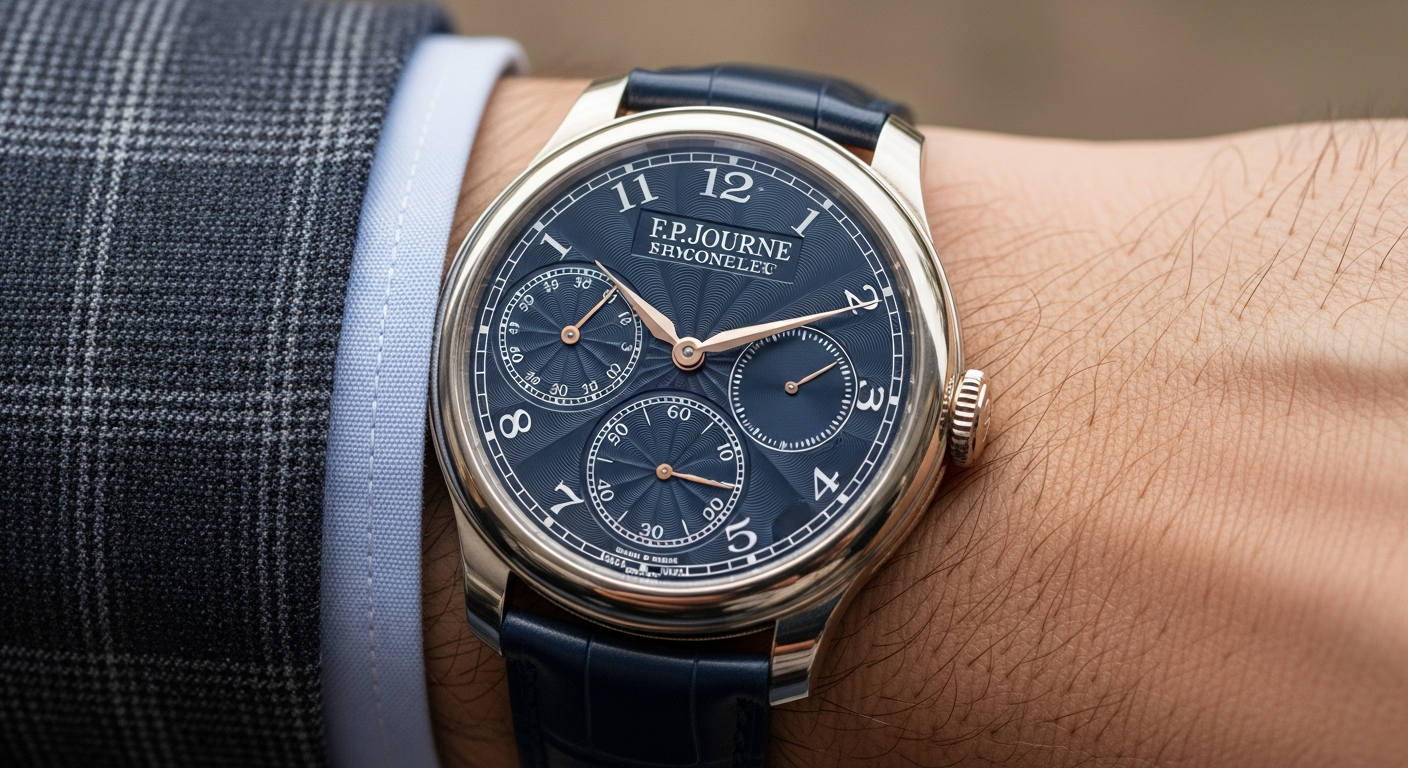
There are watches you notice because they want to be noticed, because their bezels flash like signage and their cases catch every stray beam of light as if the room exists for them alone. And then there are watches you notice the way you notice a low voice in a crowded bar: not because it’s loud, but because it’s certain. The F.P. Journe Chronomètre Bleu is like that. It does not arrive with a parade. It slides into your peripheral vision and then, somehow, takes the center without ever asking permission.
I remember the first time I saw one in person. Not on a velvet tray under jewelry-store halogens, but on someone’s wrist in the wild, in that liminal space where objects are no longer products but companions. The blue was deeper than photographs suggest, an enamel-like darkness that didn’t so much reflect light as hold onto it. The case looked almost too discreet, the proportions nearly classical, but the whole thing radiated a kind of intent. It was not trying to be modern. It was not trying to be vintage. It was trying to be itself, and that is the rarest form of confidence.
“Chronomètre Bleu,” the dial declares, with that peculiar calm of French type. The wording has always felt like a little wink. A chronometer, yes, but also a chronometer in blue, as if that color is an argument, a thesis statement. And perhaps it is. Because this watch, more than many that cost far more or look far grander, has become a shorthand for a particular kind of watch person: someone who cares about the machinery, the lineage, the stubborn choices; someone who is willing to let understatement be the flex.
It’s easy to talk about the Chronomètre Bleu as a gateway, the one Journe people buy before they buy something “more complicated.” But that framing misses what the watch actually represents. It’s not an appetizer. It’s a manifesto you can wear under a cuff.
The first thing everyone says is “tantalum,” and they say it with the faint sense of having learned a secret word. Tantalum is one of those materials that makes more sense in a laboratory than in a boutique. It’s dense, harder to machine, prone to chewing up tools, and it has that peculiar gunmetal-blue-gray sheen that seems to change its mind depending on the light. In an era when luxury often announces itself through preciousness, tantalum is almost perverse. It’s rare, but it doesn’t sparkle. It’s expensive to work with, but it doesn’t broadcast expense. It’s heavy in the hand without being loud on the wrist, the way a good book feels heavier than a glossy magazine.
That weight is where the story starts to feel like a metaphor. Because the Chronomètre Bleu is not just physically dense; it carries a density of idea. You can wear it and ignore everything behind it, but the watch resists being treated as a mere object. It keeps tugging your attention back to the fact that someone decided to make it this way, to take on the cost and inconvenience of tantalum when steel would have been easier, when precious metal would have been more obviously “luxury.” It’s a decision that only makes sense if you start from independence.
Independence is one of those words that gets used until it fades into branding fog. Every new microbrand is “independent.” Every small workshop is “independent.” The term has become a label you can slap on a caseback. But independence at the level F.P. Journe represents is not just the absence of a parent company. It is a way of accepting consequences. It means that when you choose the difficult material, you have to live with the machining time and the frustration. When you choose to make movements the way you think they should be made, you also choose the smaller output, the headaches of supply, the long lead times, the fact that your mistakes won’t be absorbed by a conglomerate’s balance sheet.
The Chronomètre Bleu is, on paper, simple: time only. But “time only” can be a kind of trap, because it sounds like the baseline, the easy one. In reality, stripping a watch down to hours, minutes, and seconds forces every other choice into sharper relief. The hands must be right. The typography must be right. The proportions must be right. The movement must be worth looking at, because there is nowhere to hide.
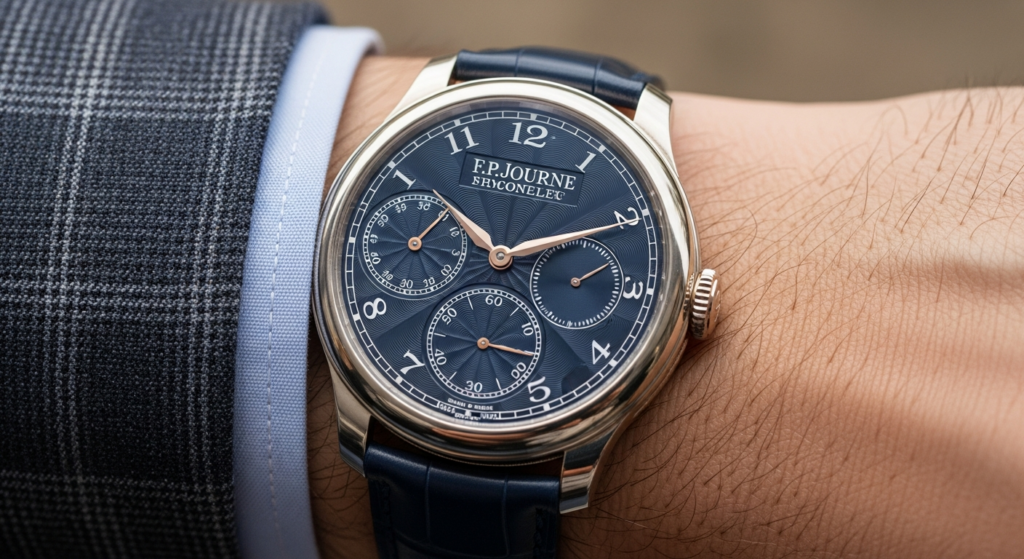
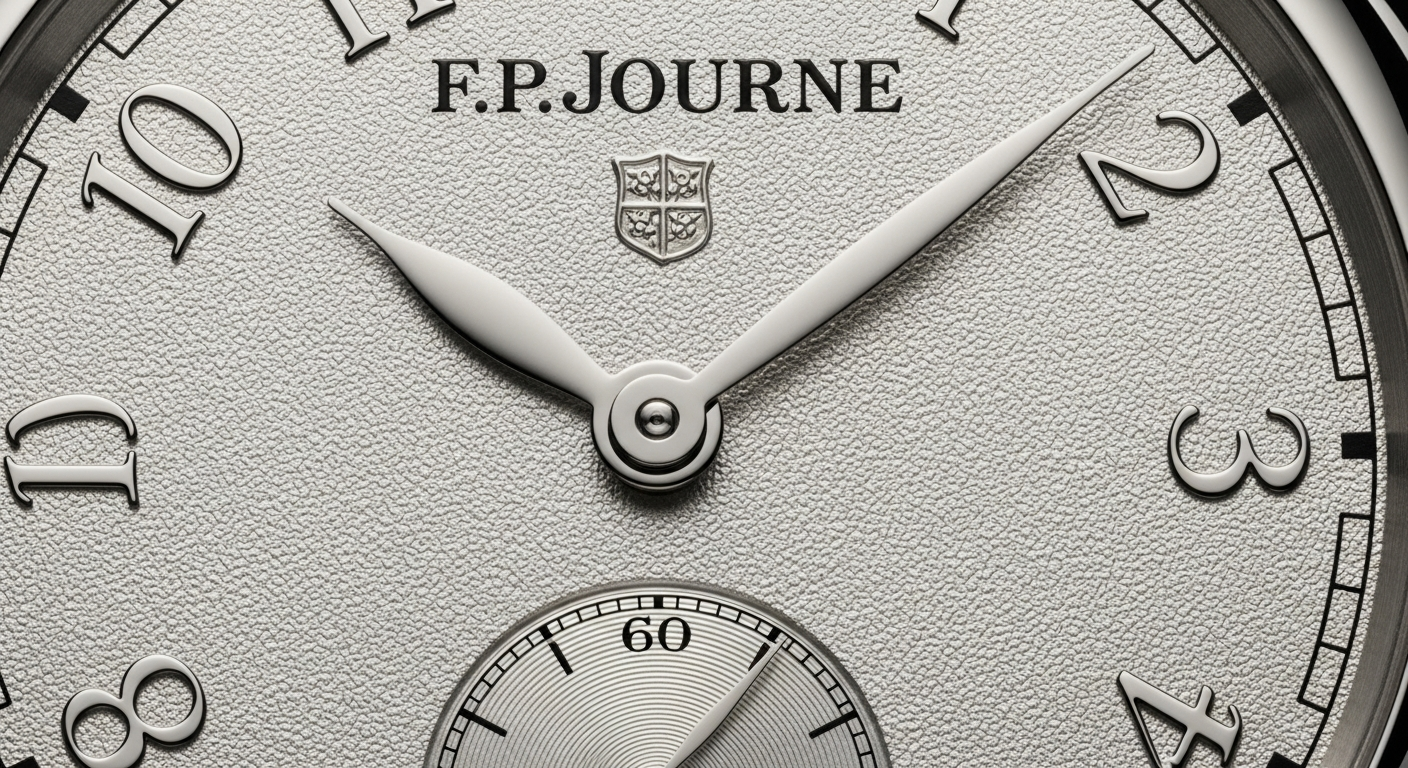
Journe has always understood that. Even from the dial side, there’s an assertion being made. The larger Arabic numerals, the delicate font, the off-center seconds at seven-thirty like a controlled asymmetry, the polished steel hands that catch light like a brief, precise gesture. The dial’s blue is not the trendy electric variety that photographs well online; it’s something older, more nocturnal. It makes the watch feel like evening wear even when you pair it with jeans.
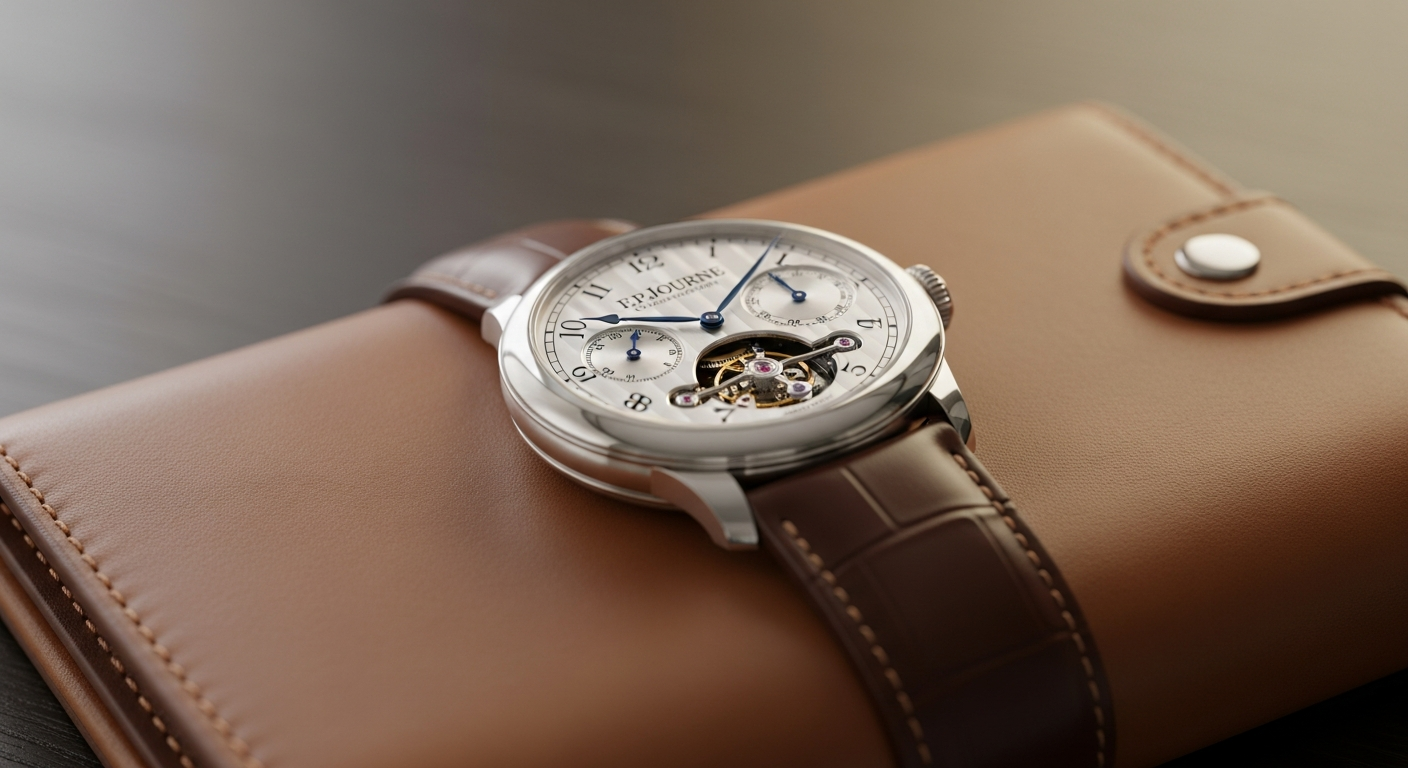
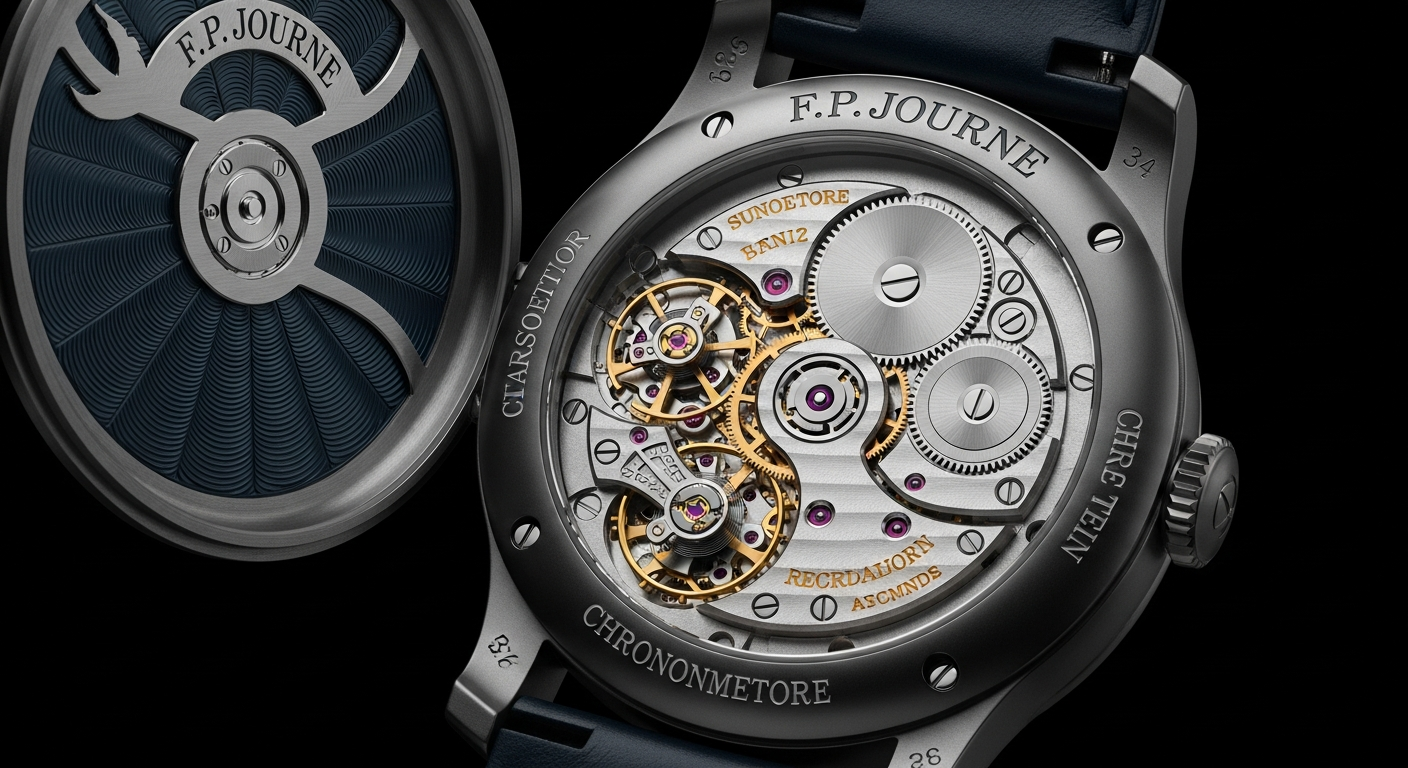
Then there’s the movement: the Calibre 1304, in rose gold, like a private luxury reserved for the owner rather than the room. This is another Journe habit that feels near-religious: gold movements not because gold improves timekeeping, but because the movement is not an afterthought. The watch is not a dial you wear with a machine hidden behind it. The machine is the watch. That proposition, that the unseen matters as much as the seen, is one of the moral arguments of high watchmaking, and Journe insists on it in a way that feels almost stubborn in 2026, when so much luxury has become a performance for other people.
The 1304’s architecture is clean, industrial in the best sense: purposeful bridges, tidy finishing, the sense that the layout was drawn by someone who needed it to work, not by someone who needed it to look ornate. And then you notice the twin barrels, and the logic starts to show itself. Two barrels for a more stable delivery of torque, a more consistent heartbeat over the power reserve. Again, not the kind of feature that sells to the casual passerby, but the kind that matters to someone who lives with the watch, who values what happens on day three of a wind as much as on day one.
When people talk about the “weight of independence,” they usually mean the romance of the lone watchmaker, the atelier, the small team doing things the hard way. But the real weight is on the product itself. Independence shows up as texture: the little decisions that would be flattened out in committee. In the Chronomètre Bleu, independence is the choice to make a watch that refuses to operate like a billboard. It’s the insistence that a time-only piece can be made with serious horological intent rather than as an entry-level concession. It’s the courage to believe that a customer might actually care about a gold movement and twin barrels more than another complication they’ll never use.
And yet, there’s also a practical, almost human side to the Chronomètre Bleu’s appeal. It fits. It wears with ease. It’s 39mm, a number that has become almost ideological in watch circles, but in this case it isn’t a stance; it’s simply right. The case is slim enough to disappear under a sleeve, but not so slim that it feels fragile. The watch doesn’t dominate your wrist; it joins it. The tantalum case has that gentle resistance to scratches that makes it feel less precious in the daily sense, even if it’s precious in the existential one.
I’ve always thought the best independent objects carry a certain duality: they are both art and tool, both statement and companion. The Chronomètre Bleu manages that duality with odd grace. If you know, you know; if you don’t, it still looks like a beautiful, restrained watch. It doesn’t punish anonymity. It rewards attention.
There’s a story people like to tell about Journe collectors, that they’re all part of a club, speaking in references: early brass movements, resonance, the holy trinity of modern independents. There’s some truth to it, but the Chronomètre Bleu complicates the stereotype. It has become, in a way, a social object—not because it shouts, but because it signals a particular alignment of values. Wearing one suggests you’ve made peace with the idea that the loudest thing isn’t the most meaningful thing. It suggests that you might prefer the long conversation to the quick joke.
Of course, the market has its own narratives. The Chronomètre Bleu has spent years being talked about as “hard to get,” as a waiting list watch, as something that floats in price like a rumor. That’s a different kind of weight: the weight of desire under scarcity, the way an object becomes a token in a broader game. It’s tempting to pretend this doesn’t matter, to insist that pure appreciation exists in a vacuum, but watches do not live in vacuums. They live in a world of status, speculation, taste, and the constant background noise of online opinion.
What’s interesting is that the Chronomètre Bleu survives that noise better than most. Even when people talk about it as an investment, the watch itself resists being reduced to a spreadsheet. A steel sports watch with a recognizable bezel can become shorthand for money in a way that’s almost immediate. The Chronomètre Bleu doesn’t do that. It demands context. It asks for a pause. It requires someone to lean in a little.
That resistance is, again, a kind of independence. Not independence from corporate ownership, but independence from the attention economy. The watch looks like it was designed by someone who assumed you would spend time with it, not scroll past it. In that sense, it feels almost anachronistic, like a finely bound notebook in a world of disappearing messages.
And when you do spend time with it, small things start to accumulate. The way the seconds subdial sits low, giving the dial a gentle tension, a feeling that it could have been centered but chose not to be. The way the numerals are big but not aggressive, like they’re there to be read rather than to decorate. The way the blue dial shifts subtly, sometimes almost black, sometimes revealing its color like a secret. The way the tantalum case catches a cooler highlight than steel, as if the light itself is slightly different around it.
You also start to understand the emotional logic behind owning something like this. It’s not just a watch; it’s proof that someone can still make things according to principle. That concept sounds lofty until you consider how rare it is to find principle embedded in an everyday object. So many products are optimized for maximum market appeal, for the broadest possible customer, for the cleanest possible story. The Chronomètre Bleu is not optimized in that way. It feels optimized for a person: someone who wants to live with an idea, not just display it.
I’ve heard people say that the Chronomètre Bleu is the most “casual” Journe, and I understand what they mean. It’s simpler, less intimidating, less obviously rarefied than some of the brand’s more complex pieces. But casual is the wrong word. The watch is not casual. It’s composed. It’s the difference between someone dressing down because they don’t care and someone dressing down because they know exactly what they’re doing.
In that composure, there’s a lesson about independence that extends beyond watches. Independence, real independence, isn’t the freedom to do anything. It’s the discipline to do the thing you believe in even when easier options are available. It’s the patience to accept that your audience may be smaller but more sincere. It’s the willingness to build a world rather than rent one.
The Chronomètre Bleu feels like the product of that discipline. It is not trying to be the ultimate time-only watch in the abstract; it is trying to be Journe’s time-only watch, with Journe’s priorities and quirks intact. It is, in a sense, the opposite of a focus-grouped luxury product. There’s no sense that features were added to justify a price. If anything, the watch seems to have been edited down to what mattered most to its maker.
And that’s where the weight comes back, heavier than tantalum, heavier than gold. When you wear a watch like this, you’re wearing the outcome of decisions that could have gone another way. You’re wearing the proof that someone can still choose the difficult path: a dial color that might be too dark for some, a case material that makes manufacturing harder, a movement metal that adds cost without adding marketing clarity. You’re wearing the idea that the invisible counts, and that the best luxury is often the luxury of integrity.
I think that’s why the Chronomètre Bleu has become such a touchstone. Not because it’s the loudest or the rarest or the most complicated. But because it sits at a crossroads of what many people want watches to be again: personal, purposeful, made with a kind of seriousness that doesn’t need to pose.
In a world where so much of what we buy is designed to be replaced, where even luxury can feel disposable when the next release arrives, the Chronomètre Bleu feels like a refusal. It refuses to chase trends. It refuses to explain itself. It refuses to be anything other than what it is. That refusal is not arrogance. It’s independence, fully realized, with all the weight that comes with it.
And sometimes, late in the day, when the room is dimmer and the blue dial turns almost midnight-black, you glance down simply to check the time and find yourself pausing. The watch is doing what it has always promised to do: measure the passing hours. But it also does something else, quietly, without complication or fanfare. It reminds you that time is not only something to be tracked. It is something to be spent, deliberately, on things that were made deliberately.