Chopard L.U.C: In-House Excellence Behind the Red Carpet
The first time you notice Chopard on a red carpet, it rarely announces itself with the kind of shouting that makes a camera swivel. It glints rather than glares. It behaves like a secret shared between the wearer and the light. Photographers capture the diamonds, the sculpted gold, the confidence that arrives when a clasp is closed and a wrist settles into its role. In those moments, Chopard is easy to file away as the jeweler of cinema—an artisan of gala-night sparkle, a house fluent in premieres and prizes. And yet, somewhere behind that bright parade, another Chopard moves with quieter determination, the one that doesn’t need a flash to justify its existence. You don’t meet it in the crush of the carpet. You learn about it later, when the tuxedos have been hung and the gowns are packed. You meet it when the conversation turns from who wore what to how something was made.
That is where L.U.C begins: in the interval after applause, in the place where glamour is not denied but rebalanced by craft. It is easy to say “in-house” now, as if the phrase alone could confer legitimacy. But with L.U.C, the insistence on in-house excellence isn’t marketing garnish; it is the narrative’s spine. There is a difference between owning attention and earning respect, and L.U.C has always seemed more interested in the latter, even if it enjoys the former when the occasion demands.
The initials themselves are a clue, a kind of signature written into the movement. L.U.C stands for Louis-Ulysse Chopard, the founder whose name suggests an older rhythm—one that predates the modern appetite for instant novelty. Invoking him is not nostalgia as costume; it’s a reminder that watchmaking, at its best, is a moral position. It argues that time is worth building carefully. It claims that beauty can be engineered, regulated, and finished until it becomes something you can live with every day, not merely admire at a distance.
There is a small irony in how often people encounter Chopard through the theater of celebrity, because L.U.C’s most compelling qualities are the ones that don’t photograph easily. A red carpet rewards surfaces: the mirror of a case, the curve of a lug, the shimmer of a dial that behaves well under harsh lighting. But the real L.U.C lives behind a caseback, in the geometry you feel rather than see—how the crown winds, how the seconds hand settles into its cadence, how the watch seems to hold itself together with calm.
That calm doesn’t happen by accident. It comes from decisions that are expensive, time-consuming, and invisible to most people who will ever wear the watch. It comes from the willingness to design rather than assemble, to imagine a movement not as a convenient catalog of parts but as a coherent philosophy. It comes from the way the brand has physically invested in the idea that watchmaking is a home, not a supply chain. When you hear enthusiasts talk about “manufacture” in reverent tones, this is what they mean: the ability to control the heartbeat, not just dress it.
The world loves the myth of the lone genius at a bench, but L.U.C’s excellence is more architectural than romantic. It is the accumulation of specialized skills under one roof, in a system where every craft has to speak to the others. Precision isn’t only a matter of tolerances; it’s a matter of language. The designer must anticipate what the finisher will reveal. The engineer must allow room for elegance. The person adjusting the escapement must trust that the case will protect the movement’s poise without smothering it. In-house, at its best, is not about isolation; it’s about accountability. You can’t blame the supplier when it’s your name on the bridge.
And then there is the idea of legitimacy, that watchmaking currency that can’t be bought with sponsorships or celebrity placements. In the landscape of fine watches, legitimacy often arrives in the form of standards: chronometer certification, demanding seals, the kind of independent verification that forces a brand to prove its claims under measurement and scrutiny. L.U.C doesn’t merely hint at this world; it participates in it. The point of a chronometer is not to romanticize accuracy but to submit to being tested. It’s an act of confidence, yes, but also an act of humility: a recognition that craft becomes credible when it can be evaluated.
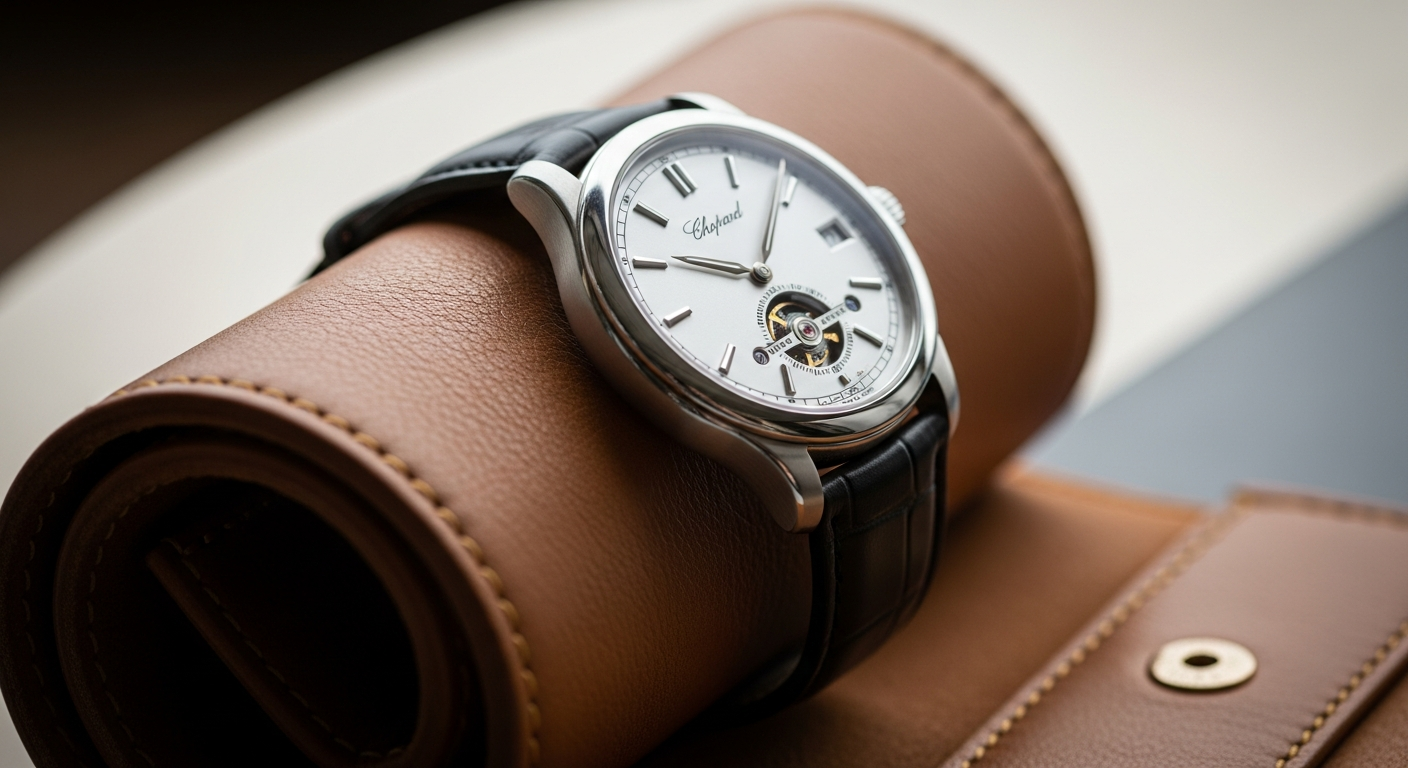
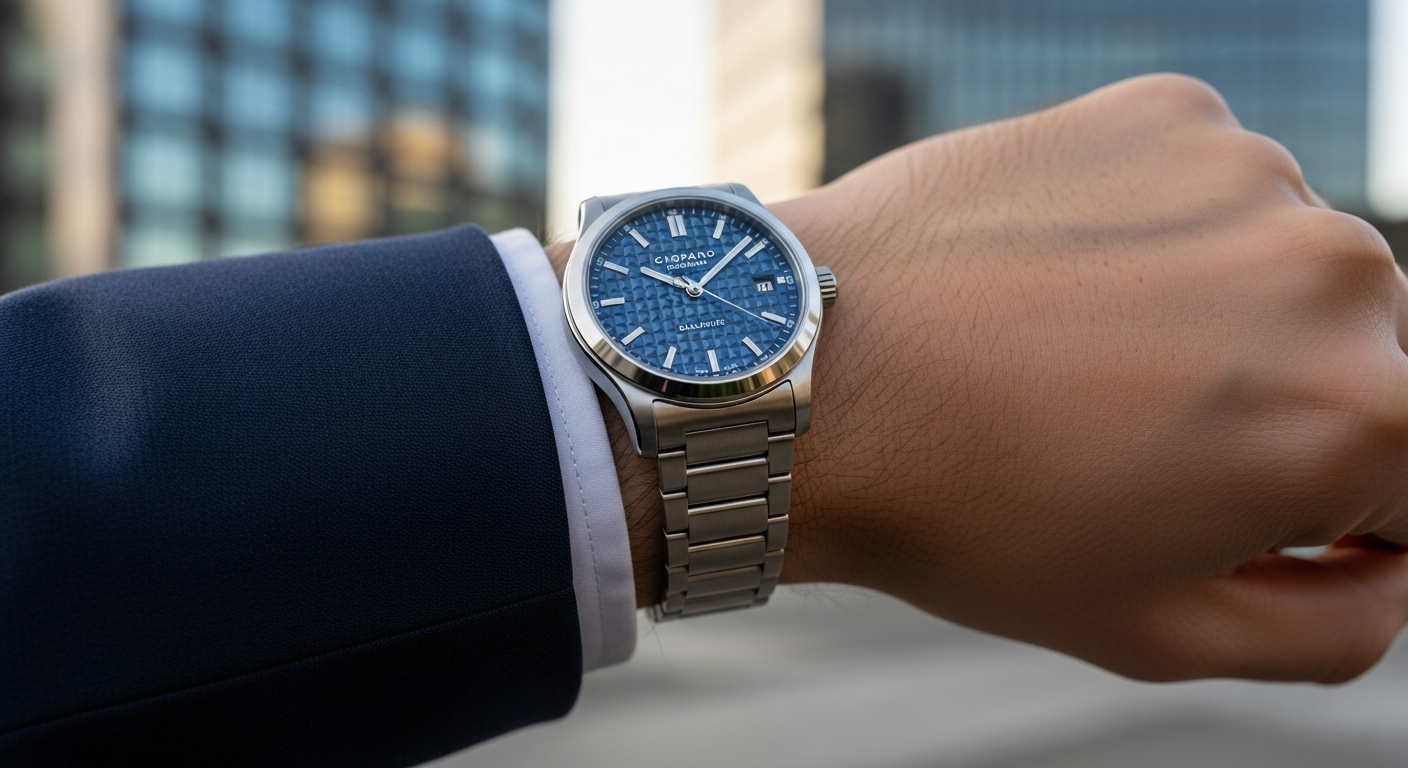
If red-carpet Chopard is about the instant of impact, L.U.C is about the long relationship. Imagine the watch not under a spotlight but at a desk on an ordinary morning, sleeve pushed back, coffee cooling, the day’s schedule a small tyranny of minutes. In that setting, the watch becomes a companion rather than a symbol, and the things that matter change. You start noticing the discipline of the dial—how it balances information and restraint. You become sensitive to how the case sits, whether it feels like a jewel you’re borrowing or a tool you own. You begin to understand that luxury, in the deepest sense, is not the price; it is the absence of friction.
That absence of friction is engineered. The winding feel is tuned. The gear train is laid out with a sensitivity to energy loss. The finishing, even when hidden, serves a purpose beyond vanity; it reduces burrs, improves reliability, and rewards the person who looks closer. Good watchmaking is full of these dual-purpose gestures, where the beautiful and the functional meet and shake hands. L.U.C speaks fluently in that dialect.
But the story gets more interesting when you consider how L.U.C sits inside Chopard as a whole. Chopard is not a small atelier living in monastic silence. It is a global luxury house that knows exactly how the world works: how events shape desire, how cinema shapes aspiration, how an object becomes an icon when it is seen in the right moment on the right person. The temptation, in such a house, would be to let watchmaking become another accessory to spectacle. To make watches that behave like jewelry, excellent at catching light and less concerned with what happens in the dark.
L.U.C resists that temptation without becoming dour. It doesn’t reject glamour; it simply refuses to depend on it. The watches can be elegant enough for black tie, but they do not require a gala to justify their existence. They are built with the idea that a watch should endure the quiet days, the days when no one is watching, the days when the only audience is you.
There is also an ethical dimension to this kind of making that is easy to miss when you only skim the surface. In-house excellence, when done seriously, implies a certain respect for labor. It suggests training, investment, continuity—people learning their craft over years, not merely executing a brief. It means the house is willing to bear the cost of mastery: the tools, the time, the mistakes that happen before something becomes second nature. Luxury often sells the illusion of effortlessness; L.U.C is one of the places where you can sense the effort that has been carefully edited out.
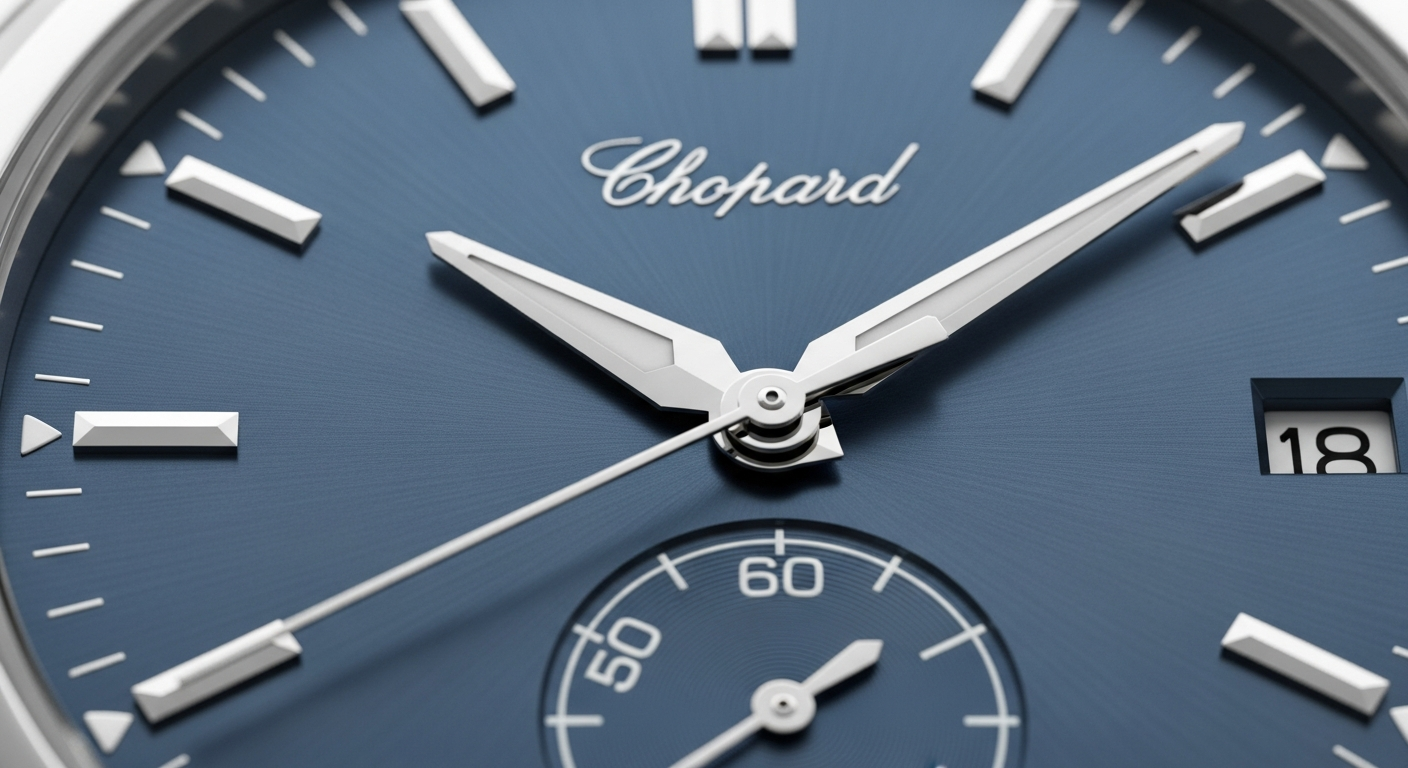
You can trace this sensibility in the way L.U.C watches often feel composed, as if they have been designed to remain desirable even when fashion changes its mind. That composure is not blandness. It’s the confidence of proportion: a dial that doesn’t need to scream, a case that isn’t trying to outmuscle your wrist. When complications appear, they tend to be integrated with a kind of calm logic. The watch isn’t trying to impress you into submission; it’s inviting you into a more patient appreciation.
That patience is, in a way, the emotional opposite of the red carpet. A carpet moment is measured in seconds: the turn, the smile, the click of shutters, the immediate circulation of images. L.U.C is measured in years: the service intervals, the developing patina, the steady accumulation of tiny memories. If jewelry can feel like punctuation—an exclamation point at the end of an outfit—then a good watch is more like grammar. It shapes the sentence of your life quietly, every day, without demanding credit.
And yet, it would be a mistake to pretend these two worlds never touch. In fact, the connection between red-carpet Chopard and L.U.C is part of what makes the story modern. The same house that dresses stars understands something profound about why people love beautiful objects: because they carry narrative. On a red carpet, the narrative is public and immediate. With L.U.C, the narrative is private and cumulative. Both are forms of storytelling, and both rely on the credibility of craft to feel real.
Perhaps that is the key to why L.U.C works. It is not an apology for glamour; it is its foundation. A house that can make a bracelet that looks inevitable on the wrist of an actor at Cannes is demonstrating one kind of mastery. A house that can make a movement that keeps time with disciplined accuracy and finishes its components to standards that satisfy the most demanding eyes is demonstrating another. When both forms of mastery coexist, the glamour stops being costume and becomes culture. It becomes something that has roots.
There is a moment that happens to many watch lovers—often unexpectedly—when they flip a watch over and see the movement for the first time, not as a technical diagram but as a landscape. Bridges curve like architecture. Screws catch the light like tiny punctuation marks. Edges are softened and polished with a tenderness that feels almost human. Even if you don’t know the names of the techniques, you can sense the intention: someone wanted this to be beautiful even when no one would see it. That is the kind of beauty that changes the way you think about luxury, because it isn’t transactional. It is offered without guarantee of applause.
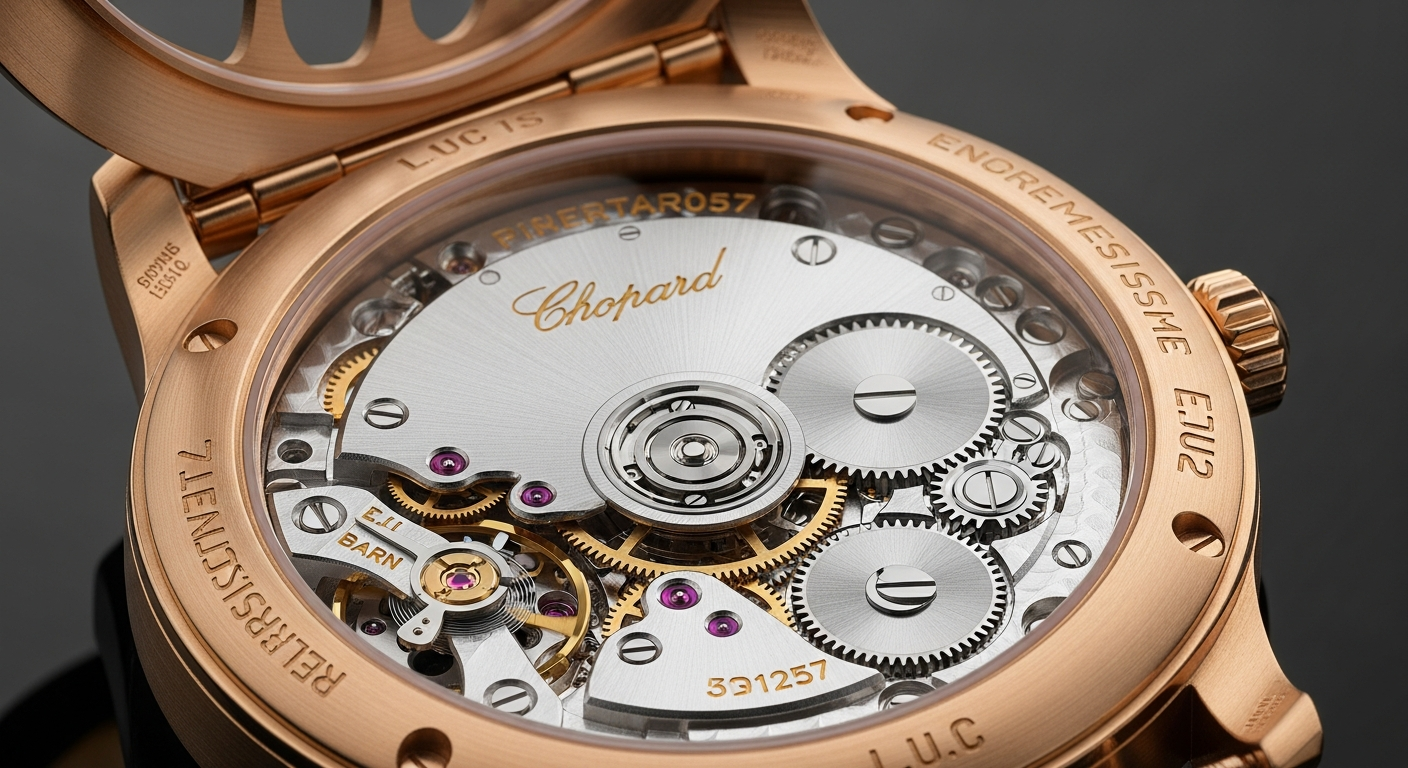
In L.U.C, that hidden beauty becomes a kind of rebuttal to the cynical idea that luxury is only about being seen. It argues instead that the most persuasive status symbol is competence. Not the competence of performance, but the competence of construction. Not “look at me,” but “look what we can do.”
This is why the phrase “behind the red carpet” matters. It doesn’t mean Chopard is leaving the carpet behind. It means there is another room in the same house, one you can’t enter with a camera crew. In that room, time is handled with care, as if it were something you could offend by rushing. In that room, excellence is not a mood but a method. And in that room, the brand’s public radiance finds its private justification.
When you step back and consider what L.U.C represents, it feels less like a product line and more like a pledge. A pledge that the brand’s reputation will not rest solely on the sparkle of an evening. A pledge that the name on the dial also belongs on the parts you never see. A pledge that if you buy into the story, you are not merely buying a moment—you are buying the result of a long, deliberate discipline.
The red carpet will continue to do what it does: turn craftsmanship into spectacle, translate artisanship into shimmer, make the world pause for a fraction of a second to look. But the deeper achievement is what happens when the lights go down and the watch keeps running with the same assured rhythm. That is the real performance, repeated endlessly, with no audience required. In that repetition—steady, measured, unshowy—you find the essence of L.U.C: in-house excellence that doesn’t need the red carpet, even as it quietly dignifies everything that happens on it.