Chopard L.U.C and the Secret War for Finishing Supremacy
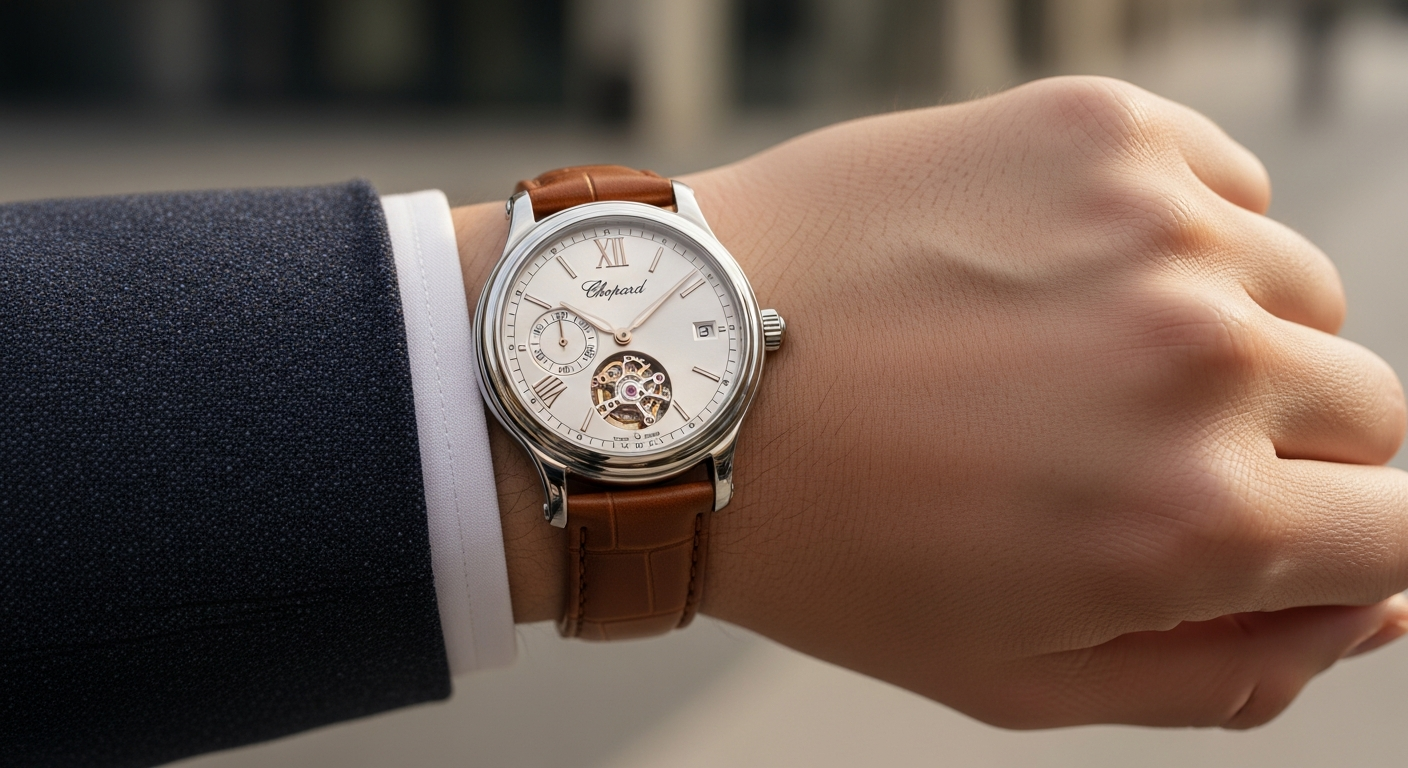
There is a particular hour in Geneva when the city feels like a watch in mid-assembly: still, precise, and strangely alive. The day’s noise has been filed down. The lake becomes a dark dial. Even the streetlights seem to tick. It’s the hour when the people who make their living with time begin thinking about how time looks, not just how it passes. In that quiet, the real battles in Swiss watchmaking are rarely fought with complications or marketing slogans. They are fought in light, at the edge of a bevel, in the sharpness of an interior angle, in the way a stripe catches and then releases the eye.
Finishing is where watchmaking becomes a kind of confession. It is the part you could, in theory, omit and still have a functioning watch. That is precisely why it matters. Finishing is labor that declares intention. It tells you whether a brand believes in the hidden, whether it respects the unseen surfaces that no customer strictly needs to see, whether it is willing to spend time on beauty that offers no practical advantage except the quiet knowledge that it is there. That is why there is a secret war for finishing supremacy: because it isn’t merely about polish, it’s about legitimacy.
Chopard’s L.U.C is an unlikely general in that war, which is the first reason its story is so revealing. For decades, Chopard lived in two worlds at once. In the public imagination, it was the house of jewels and red carpets, of a glamorous presence that could easily eclipse whatever happened in its workshops. But behind the showpieces and spotlights, there was a different ambition taking shape, one suited not to the flash of premieres but to the slow glare of a loupe. In the 1990s, when prestige watchmaking was rearranging itself after the quartz crisis, Chopard decided it would not merely buy movements and dress them well. It would build a voice of its own, and that voice would be called L.U.C—named for Louis-Ulysse Chopard, the founder whose nineteenth-century workshop had been defined by precision.
The decision to create a true manufacture movement is always presented as a romantic turning point, but inside the industry it is also a kind of provocation. It says: we want to sit at the table with those who have always controlled the conversation. And in Swiss watchmaking, that conversation gets serious when the talk turns to finishing. The old aristocracy of the craft—names spoken softly in collectors’ circles—has long treated finishing as a password, a way to separate the merely expensive from the truly great. Chopard entered that world with a charm that could have been mistaken for naïveté, and then it began doing something that people did not expect: it started finishing movements as though it had something to prove.
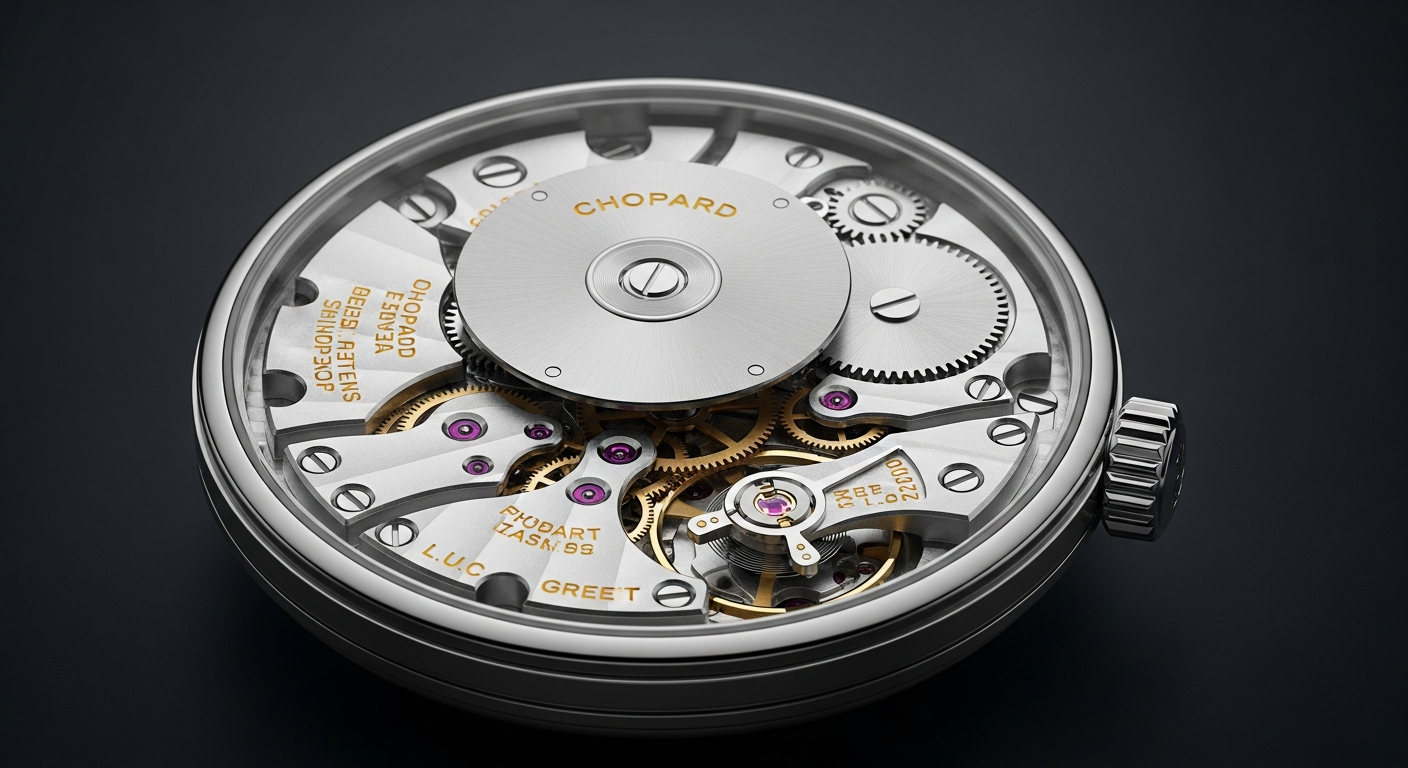
If you want to understand the war, you have to understand the battlefield. Finishing is not one thing. It is a constellation of practices, each with its own language and politics. There is anglage, the beveling of edges until they shine like ribbons of light. There is perlage, those overlapping circles that look like a field of pearls beneath the bridges. There are Côtes de Genève, the striping that seems simple until you see how it can be done lazily or with authority. There is black polishing, where a steel surface alternates between deep black and bright reflection depending on the angle. There are sharp internal corners, details so demanding that machines usually round them off and the only way to keep them crisp is to use hand tools and time, the two most expensive ingredients in Switzerland.
Then there are the rules that are not written in any book, the ones collectors learn by instinct. The depth of a bevel. The evenness of a stripe. The way screw heads are finished. The treatment of sink holes and countersinks. The harmony of a movement architecture that seems designed not just to hold parts but to present them. The connoisseur’s gaze is ruthless, but not cruel. It is simply trained. It can tell when a brand is doing the minimum required by a label and when it is pursuing finishing as an ethos.
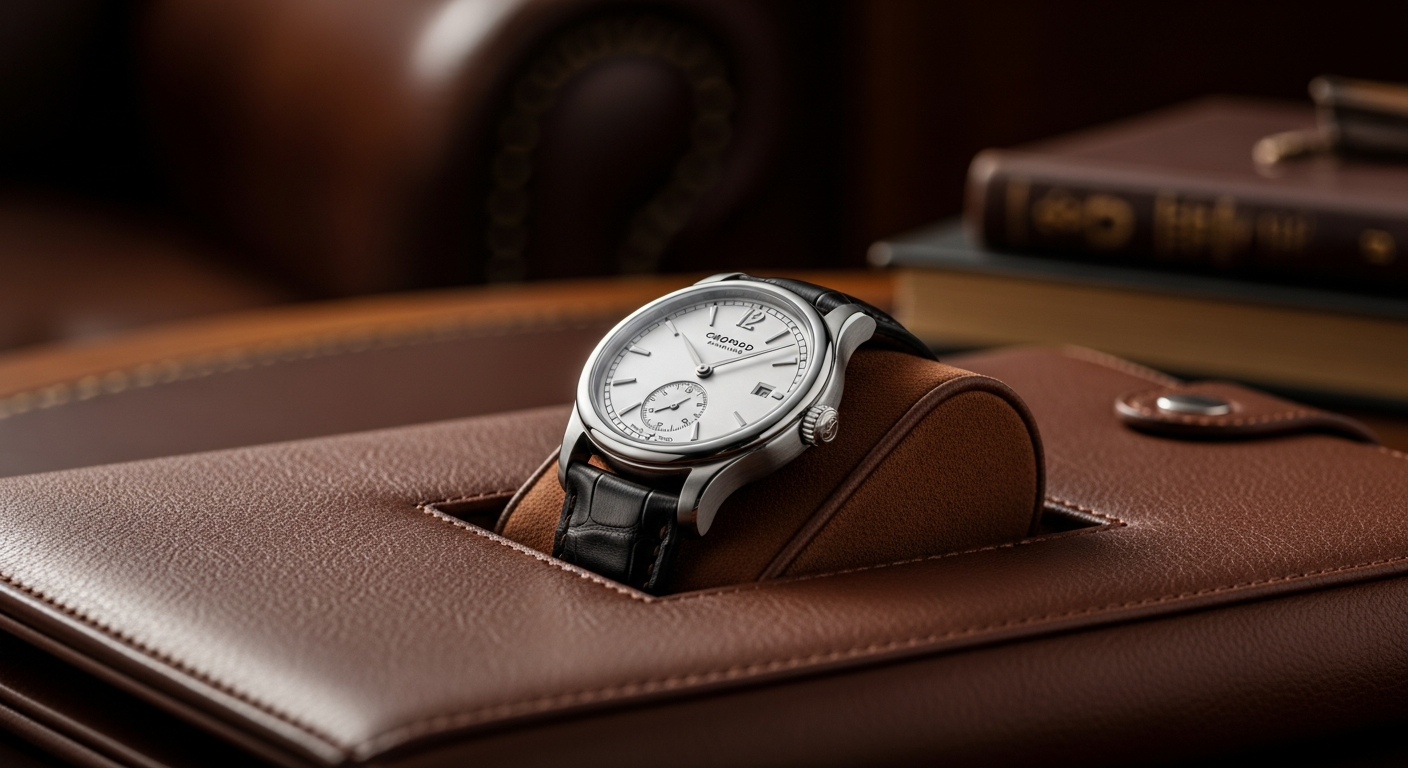
Chopard understood early that if L.U.C was going to be taken seriously, it needed more than a good movement. It needed a movement that looked like it belonged. So it built calibres that were not content to hide behind a dial. It made them the point. The early L.U.C 96.01-L is often discussed for its micro-rotor and its elegant thinness, and rightly so, but the quiet audacity was that it arrived already speaking the dialect of high finishing. Bridges dressed with Geneva stripes. Anglage catching light along the edges. A sense that the movement was composed, not merely assembled. It was a declaration: we can play here too.
But the secret war is not fought in the open with press releases. It is fought in workshops and in the minds of those who know how long things take. When a brand begins finishing at a higher level, the entire economic logic of production shifts. You can’t just decide to be excellent and then scale it infinitely. Hand finishing creates bottlenecks, and bottlenecks create choices. A brand can choose to make fewer watches, charge more, hire and train more artisans, or compromise. The war is, in other words, a war against time itself. Every extra stroke on a bevel is a decision to spend minutes that could have been used to make another watch.
In that context, the Fleurier Quality Foundation seal becomes more than a badge. It is a kind of treaty, a formalized promise that a watch is Swiss-made in a meaningful sense, chronometrically tested, finished properly, and robust in real-world use. Chopard was a founding participant in this standard, and that matters because it reveals a specific kind of confidence. Many brands prefer standards that are either purely aesthetic or purely technical. Fleurier demands both and then asks the watch to survive a trial that resembles life. It’s as if the movement must not only be beautiful under magnification but also ready to be worn, knocked, and trusted.
That combination is where Chopard’s strategy becomes interesting. Some maisons chase finishing like a museum piece, perfect for display and fragile in spirit. Others chase performance and treat finishing as a checklist. L.U.C has been trying to carve a third path: finishing that is serious, sometimes lavish, but anchored to the identity of a watch meant to be owned rather than merely admired. That balance is not easy, and it is never static. Each release is, in a way, another skirmish in the secret war.
Consider what it means for Chopard to compete against brands whose entire mythology is built on finishing supremacy. There are houses that have spent generations training the market to look for particular signs, and there are independents who can devote all their output to a few hundred pieces a year, spending time in ways larger brands cannot. Chopard, by contrast, carries the weight and opportunity of a broader business. It has a jewelry empire and mainstream collections that keep the lights on, but L.U.C must still justify its place at the top table. It must do so not with scarcity alone but with credibility.
Credibility in finishing is strange because it is both obvious and invisible. A collector can see it through a sapphire caseback, but only if they know what to look for. And the deeper you look, the more you realize finishing is not simply about decorative techniques. It is about discipline. Are the stripes clean or do they fray at the edges? Do the bevels maintain consistent width as they travel around a bridge? Are there rounded corners where sharp ones should be? Are the screw slots polished and their heads chamfered? Is the typography engraved or etched? Even the choice between a stamped part and one that has been carefully shaped can alter the entire emotional register of a movement.
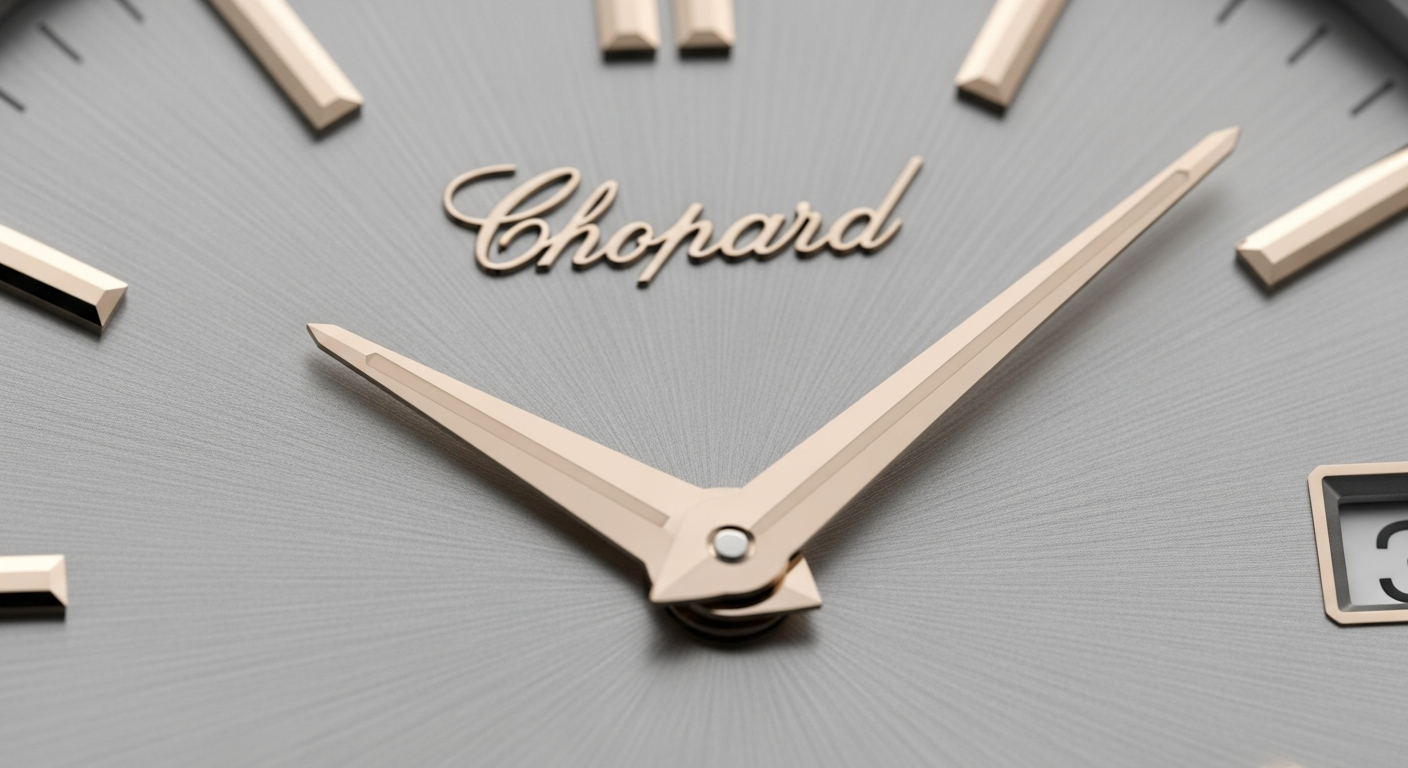
The thing about a “war” for finishing supremacy is that it is not judged by a single committee. It is judged by a dispersed network of obsessive eyes: watchmakers who know the effort behind each surface, retailers who feel the shift in interest among clients, collectors who post macro photographs and argue about angles in late-night forums, journalists who have learned to photograph reflections rather than just take notes. And in this network, reputation can be won slowly and lost quickly. One lazy movement can haunt a brand for years; one exceptional calibre can change the tone of every conversation that follows.
Chopard’s L.U.C has earned its reputation the hard way, through repetition. It has put finishing in front of people over and over again, not as a one-off trophy but as a consistent signature. The L.U.C line is full of movements that seem intent on reminding you: we know you are looking. Some of that is visible in the restrained beauty of its bridges and the steadiness of its decoration. Some of it is more structural, in choices like micro-rotors, hand-wound calibres that invite thinness, and movement layouts that prioritize symmetry and elegance. It is the kind of finishing that often doesn’t scream. It simply stands there, confident, and waits.
That confidence has a particular flavor at Chopard because it comes from a brand that does not need to win this war to survive. It chooses to fight. That choice is what makes L.U.C compelling. There is something almost stubborn about it, a refusal to let the jewelry identity be the final word. L.U.C is Chopard insisting on being judged by a different set of criteria, in the harsh light of craft.
And craft, in the end, is about hands. The more a brand relies on finishing as a differentiator, the more it must invest in human skill that cannot be rushed. Training a finisher to produce perfect anglage is not a quick apprenticeship. It is a slow education in pressure, in consistency, in how metal responds when you push it too hard, in how to keep a line straight while working around curves, in how to see imperfections before the customer ever will. There is romance in that, but also vulnerability. Skilled hands retire. Younger hands must be convinced that this kind of work is worth dedicating their life to. In a world where speed and scale dominate, finishing is an argument for patience.
There is also the matter of taste. Finishing supremacy is not just about doing more; it is about doing what is appropriate. Over-finishing can be as crude as under-finishing if it disrupts the coherence of the piece. The best L.U.C watches tend to understand that restraint can be a form of luxury. The decoration supports the architecture. The visual rhythm of stripes, perlage, and polished bevels doesn’t fight for attention; it guides it. The result is movements that feel complete rather than embellished after the fact.
It helps, too, that L.U.C exists inside a company with access to materials and crafts that many pure watch brands envy. Chopard’s work with ethical gold, for instance, is often discussed as a corporate responsibility story, but it also feeds into a larger idea of legitimacy. When a brand is trying to prove it belongs in the upper tier, the sources of its materials, the seriousness of its manufacturing, and the integrity of its claims all become part of the picture. Finishing is about what you can see; provenance is about what you can’t. Together they form a kind of moral and aesthetic whole.
And yet, the war remains secret because its most meaningful moments happen far from the boutiques. They happen when a finisher decides to redo a bevel because the light breaks unevenly; when a supervisor rejects a bridge because a stripe is slightly inconsistent; when a watchmaker notices a steel part that could be brought to a deeper black polish and chooses to spend another hour. These decisions are not always visible in a marketing photo, and they are almost never profitable in the short term. They are a kind of discipline that only makes sense if you believe reputation is made in the margins.
The irony is that many buyers never flip the watch over. They may never look through a loupe. They may never notice whether the interior corner is sharp or slightly rounded. But the war isn’t fought for the casual glance. It is fought for the serious gaze, the gaze that turns a purchase into a long-term relationship. When someone buys a watch like an L.U.C, they are often buying not just a design but the feeling that the brand has respected them enough to finish what they might never see. That respect is contagious. It becomes the story they tell other collectors. It becomes the quiet authority that turns a name into a reference point.
Chopard’s L.U.C, then, is not merely competing for trophies. It is competing for belief. It is asking the world to believe that excellence can come from a house known for glitter, that a brand can be both public and private, both glamorous and monastic. It is asking to be judged on the same unforgiving criteria as the traditional finishing champions. And every time an L.U.C movement catches the light just right—every time the stripe ends cleanly, every bevel holds its line, every polished screw head reflects like a tiny mirror—it wins a small victory in that ongoing, largely unspoken war.
The strangest part is that finishing supremacy is a moving target. As tools improve, as collectors become more educated, as independents raise the bar with pieces that look like they were carved from patience itself, the definition of “best” keeps shifting. The war has no final treaty. It has only the present tense: what have you done lately, and was it done with care?
Perhaps that is why L.U.C matters now more than ever. It represents a kind of ambition that is increasingly rare: ambition that is willing to be measured not just by price or prestige but by evidence. Evidence in the form of a bridge, a bevel, a polished steel part that turns black at a certain angle. Evidence that time was spent. Evidence that someone, somewhere in Fleurier, believed the hidden could be beautiful.
When the Geneva night finally gives way to morning, the light returns and the city begins to move again. There are meetings, launches, announcements, the outward life of watchmaking. But in the quiet rooms where movements are finished, the war continues the way it always has: one edge at a time, one shimmer of polish at a time, one decision to redo a piece rather than let it pass. In that war, Chopard’s L.U.C has become a formidable presence—not by shouting, but by insisting, patiently, that the truth of a watch is written in the parts you weren’t meant to notice.